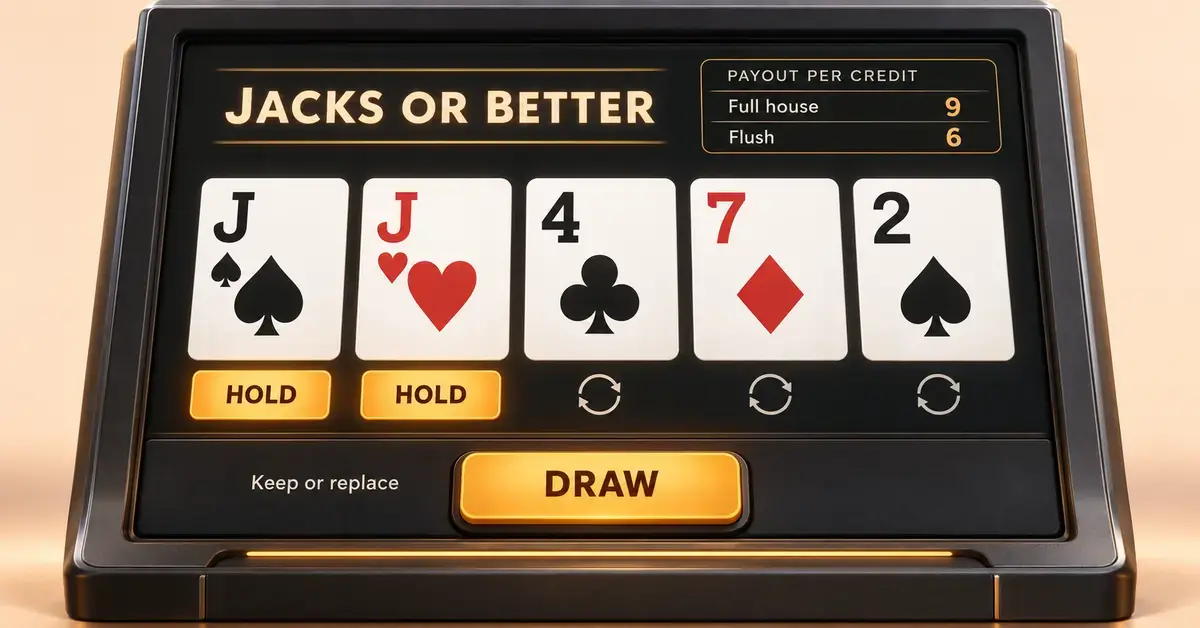
Video poker is a machine game that blends the look of a slot machine with the hand rankings of five-card draw poker. You bet, the machine deals five cards on screen, you choose which to keep and which to replace, and the machine pays you from a fixed pay table based on the poker hand you end up with. There is no dealer and no other players — you are simply trying to build a paying hand, and every payout is printed on the screen before you play. This guide explains how the machine decides your cards, how to read a pay table, what return to player (RTP) really means, and how the main variants differ.
Key Facts
- Game type: single-player machine game based on five-card draw poker
- How you win: build a paying poker hand; payouts are fixed by the pay table shown on screen
- Deal: five cards from a simulated, reshuffled 52-card deck, with one draw to replace cards
- Odds engine: a random number generator (RNG) — each hand is independent
- Best common pay table: 9/6 Jacks or Better, about 99.54% RTP with perfect strategy and max coins
- House edge: as low as ~0.46% on full-pay 9/6 — one of the lowest on the casino floor
- Bet max: five coins unlocks the 4,000-coin royal flush and the full RTP
- Legal age in Canada: 19, or 18 in Alberta, Manitoba and Quebec
What is video poker?
Video poker is a single-player electronic game built around the draw-poker format. The cabinet looks much like a slot machine, but instead of spinning reels you are dealt a five-card poker hand and given one chance to improve it. Unlike most casino games, the full list of winning hands and exact payouts is shown on the machine, so you always know what each result pays before you commit a coin.
The game sits between slots and table poker. Like a slot, outcomes are produced by a random number generator and you play against the machine, not against other people. Like poker, the result depends partly on the decisions you make — which cards to hold — so two players dealt the same hand can finish with very different results. That decision element is why video poker, played well on a good pay table, can carry one of the lowest house edges on the casino floor.
How a video poker machine deals cards
A video poker machine deals from a simulated, freshly shuffled 52-card deck on every hand. A random number generator (RNG) runs continuously inside the cabinet, and the moment you press “Deal” it selects your five opening cards. The same shuffled deck then provides the replacement cards when you draw. Each card is equally likely, and the machine has no memory of previous hands.
This is the same core technology that drives modern slots. If you want the longer explanation of how these chips produce fair, independent results, see our guide to how slot machines work. The key point for video poker is that the odds are fixed by the rules of a 52-card deck — the machine is not deciding whether you should win, it is simply dealing cards.
Is video poker random or rigged?
Video poker results are random within the fixed odds of a card deck, not rigged against you on a hand-by-hand basis. A regulated machine does not look at your balance, your past results or how long you have been playing and then decide to deal you a bad hand. The house advantage is built entirely into the pay table — the fixed amounts each hand pays — rather than into crooked deals. That is also why a hand being “due” is a myth: every deal starts from a full, reshuffled deck.
Video poker rules: the basic sequence
The core of every video poker game is the same simple loop. Learning this sequence is enough to sit down at almost any machine:
- Choose your denomination and bet. Pick a coin value (for example 5¢, 25¢ or $1) and how many coins to bet per hand, from one to five.
- Press Deal. The machine deals five cards face up.
- Hold the cards you want to keep. Tap or press “Hold” under each card you want to keep. You can hold all five, some, or none.
- Draw. Press “Draw” (often the same “Deal” button) and the machine replaces every card you did not hold with new cards from the same deck.
- Get paid. The machine checks your final five-card hand against the pay table and credits any win automatically.
That is one complete hand. There is only ever one draw — unlike home poker, you do not get multiple rounds of card swapping. Your single decision about which cards to hold is where all the skill lives.
Which poker hands pay in video poker
Video poker uses standard poker hand rankings, but most games only start paying from a minimum hand upward. In the most common game, Jacks or Better, you need at least a pair of jacks to win anything — a lower pair pays nothing. From strongest to weakest, the hands that typically pay are:
- Royal flush — A-K-Q-J-10, all the same suit. The jackpot hand.
- Straight flush — five cards in sequence, all one suit.
- Four of a kind — four cards of the same rank.
- Full house — three of a kind plus a pair.
- Flush — five cards of one suit, any order.
- Straight — five cards in sequence, mixed suits.
- Three of a kind — three cards of the same rank.
- Two pair — two separate pairs.
- Jacks or better — a pair of jacks, queens, kings or aces.
Variants change this list. Games with wild cards, such as Deuces Wild, add new categories like five of a kind and “wild royal flush,” and they usually raise the minimum paying hand because wild cards make strong hands easier to build.
How to read a video poker pay table
A pay table is the grid printed on the screen showing how many coins each hand pays for each coin bet. It is the single most important thing to check, because two machines that look identical can pay very differently. Pay tables are usually named by two numbers — the payouts for a full house and a flush on a one-coin bet.
A “9/6” Jacks or Better machine pays 9 coins for a full house and 6 for a flush. This is the best common version, known as “full-pay.” A “6/5” machine pays only 6 for a full house and 5 for a flush — the same game, but with a noticeably worse return. Here is the full-pay 9/6 Jacks or Better schedule, which is the industry benchmark:
| Hand | 1 coin | 5 coins (max) |
|---|---|---|
| Royal flush | 250 | 4,000 |
| Straight flush | 50 | 250 |
| Four of a kind | 25 | 125 |
| Full house | 9 | 45 |
| Flush | 6 | 30 |
| Straight | 4 | 20 |
| Three of a kind | 3 | 15 |
| Two pair | 2 | 10 |
| Jacks or better | 1 | 5 |
Notice the royal flush. At one to four coins it pays 250 per coin, but at five coins it jumps to 4,000 — far more than the straight 1,250 you would expect. That jump is the reason experienced players bet maximum coins, and it is explained in its own section below.
RTP and house edge in video poker
Return to player (RTP) is the percentage of all money wagered that a game pays back over the long run; the rest is the house edge. For full-pay 9/6 Jacks or Better, the theoretical RTP is about 99.54% with perfect strategy and max-coin play, leaving a house edge of roughly 0.46%. That is one of the lowest edges in any casino, which is why video poker is often cited alongside blackjack as a low-edge game. For the broader picture of how these numbers work across every game, see our explainer on house edge and return to player (RTP).
Two things change that number dramatically:
- The pay table. The same game on a worse schedule returns far less. Full-pay 9/6 returns about 99.54%, but 9/5 drops to about 98.45%, 8/5 to about 97.30%, and 6/5 to about 95.00%. A difference of one or two coins on the full house and flush can cost you several percent.
- Your decisions. Every RTP figure assumes you make the mathematically correct hold on every hand. Real players rarely do, so the return they actually get is lower. Poor decisions, not the machine, are usually the biggest leak.
Two cautions are worth stating plainly. First, RTP is a long-run average over hundreds of thousands of hands — it is never a promise for a session, and short-term swings are large. Second, a published return above 100% (as with full-pay Deuces Wild) describes a theoretical mathematical edge under flawless play on a machine that is now extremely rare; it is not a realistic expectation of profit.
Pay Table Comparison
| Variant (pay table) | Return to player* | Notes |
|---|---|---|
| Full-pay Deuces Wild | ~100.76% | All four deuces wild; theoretical edge under perfect play, now very rare |
| 9/6 Jacks or Better | ~99.54% | The “full-pay” benchmark and best beginner game |
| 8/5 Bonus Poker | ~99.17% | Extra pay for some four-of-a-kind hands |
| 9/6 Double Double Bonus | ~98.98% | Big quads with a kicker; smaller hands pay less |
| 9/5 Jacks or Better | ~98.45% | Short-pay version of the standard game |
| 8/5 Jacks or Better | ~97.30% | Common short-pay; avoid if a 9/6 is available |
| 6/5 Jacks or Better | ~95.00% | Worst common Jacks or Better schedule |
*Long-run theoretical returns assuming optimal strategy and maximum-coin play. Real returns are lower when players make mistakes, and short-term results vary widely.
Why bet maximum coins?
Betting the maximum (usually five coins) is worth it because of the royal flush bonus. Most hands pay in straight proportion to the number of coins you bet, but the royal flush does not. On Jacks or Better, a royal pays 250 coins per coin for one to four coins, but 4,000 coins — equal to 800 per coin — on a five-coin bet. That oversized top prize lifts the game’s overall RTP by roughly 1–2% when you bet max.
The practical takeaway is simple: if betting five coins at your chosen denomination is beyond your budget, step down to a lower denomination rather than betting fewer coins. For example, five coins on a 25¢ machine (a $1.25 bet) captures the full royal payout, whereas one coin on a $1 machine does not — even though both risk a similar amount. Betting below max quietly raises the house edge against you.
Common video poker variants
Dozens of video poker games exist, but most are built on a handful of templates. The hand rankings are similar; what changes is the pay table and, in some games, the use of wild cards. Knowing the main families helps you spot which machine you are sitting at.
Jacks or Better
The original and most common game. You need at least a pair of jacks to win, there are no wild cards, and the full-pay 9/6 version returns about 99.54%. It is the best game for beginners because the strategy is the simplest and the odds are transparent.
Bonus Poker and Double Double Bonus
These are Jacks-or-Better variants that pay extra for certain four-of-a-kind hands. Bonus Poker boosts the payout for quad aces and low cards; the 8/5 version returns about 99.17%. Double Double Bonus pays even more for four aces with a specific kicker card, but balances it by paying less on smaller hands — the 9/6 version returns about 98.98%. These games offer bigger, rarer jackpots at the cost of more frequent small losses.
Deuces Wild
Here all four 2s (deuces) are wild and can stand in for any card, which creates new paying hands such as five of a kind, a wild royal flush and four deuces. Because wild cards make strong hands easier, the minimum paying hand rises to three of a kind. The genuine “full-pay” Deuces Wild schedule returns about 100.76% with perfect strategy, but it is now very rare; the versions you will actually find return less and require their own strategy chart.
Video poker vs slots and table poker
Video poker is often confused with both slots and table poker, but it differs from each in important ways.
Versus slots: both are RNG machines, but a slot’s payout structure is hidden and its RTP is usually lower (commonly 92–96%), while video poker shows every payout on screen and lets your decisions affect the outcome. You cannot influence a slot spin after you press the button; in video poker, your hold decisions change your expected return.
Versus table poker: table poker is played against other people, where bluffing, reading opponents and betting rounds decide the pot. Video poker has no opponents and no bluffing — you play only against a fixed pay table, and there is exactly one draw. The shared language is hand rankings; almost everything else is different.
Common video poker mistakes
Most of the money lost at video poker comes from avoidable errors rather than bad luck. The most common mistakes are:
- Playing a short-pay machine. Sitting at a 6/5 or 8/5 Jacks or Better when a 9/6 machine is nearby can cost several percent of RTP. Always check the full house/flush numbers first.
- Not betting max coins. Betting fewer than five coins forfeits the enhanced royal-flush payout and raises the house edge.
- Keeping the wrong cards. Holding a “kicker” with a pair, chasing an inside straight, or breaking a made flush to chase a royal are classic errors. The correct hold is a matter of math, not instinct.
- Using the wrong strategy for the game. Jacks or Better, Deuces Wild and Double Double Bonus each need a different strategy; a chart for one will cost you money on another.
- Treating theoretical RTP as a guarantee. A 99.5% return does not mean you lose only half a percent in a session — variance means real sessions swing far wider in both directions.
Where video poker came from
Video poker emerged in the 1970s as video display technology reached casino floors. Dale Electronics’ “Poker-Matic” is usually described as an early electronic video poker machine from the early 1970s, but the game only took off commercially later in the decade. The figure most often credited with popularizing it is William “Si” Redd, whose company worked with Reno-based Fortune Coin Company to bring a game called “Draw Poker” to market around 1979. Redd’s venture, first known as Sircoma, was later renamed International Game Technology (IGT) and became a major slot and gaming manufacturer. By the early 1980s video poker had become one of the most popular machine games in casinos, a position it still holds in many markets today.
Who video poker suits
Video poker suits players who enjoy making decisions, want transparent odds, and are comfortable learning a little strategy. Because the pay table is visible and a good machine carries a very low house edge, it rewards patience and study more than most machine games. It is less suited to players who want a purely passive experience — for that, slots require no decisions at all.
In Canada, video poker machines are found on the gaming floors of land-based casinos regulated by each province, alongside slots and electronic table games. The legal age to play is 19 in most provinces and 18 in Alberta, Manitoba and Quebec. Wherever you play, the responsible approach is to treat it as paid entertainment with a cost, not a way to make money — even the best machine, played perfectly, is designed to keep a small edge for the house over time.
Responsible Gambling
Video poker is a form of gambling, and no pay table, strategy chart or bankroll system changes the fact that the house keeps a long-run edge. Strategy can lower that edge but never remove it on the machines you will realistically find, and demo or practice play does not improve your odds of winning real money. Set a budget you can afford to lose, treat any winnings as a bonus rather than income, and never chase losses.
The legal gambling age in Canada is 19, except in Alberta, Manitoba and Quebec, where it is 18. If gambling is no longer fun — or if it is affecting your finances, mood or relationships — free, confidential help is available. See our guide to responsible gambling in Canada and the full list of provincial gambling help lines. This article is for information only and is not gambling, legal or financial advice.
Sources
Frequently Asked Questions (FAQ)
Is video poker a game of skill or luck?
Both. The cards you are dealt are random, but your decision about which cards to hold affects your long-run results. Correct strategy on a good pay table produces a much higher return than guessing, which is why video poker is considered one of the lowest-edge machine games.
What does a 9/6 pay table mean?
The numbers refer to the one-coin payouts for a full house (9) and a flush (6) on Jacks or Better. A 9/6 machine is the best common version, returning about 99.54% with perfect play. Lower numbers, such as 8/5 or 6/5, mean a worse return for exactly the same game.
Why should I bet five coins instead of one?
Because the royal flush pays disproportionately more at five coins — 4,000 coins instead of 250 per coin. That bonus raises the game’s overall return by roughly 1–2%. If five coins is too much, drop to a lower denomination rather than betting fewer coins.
Can you actually beat video poker?
On almost every machine you will find, no — the house keeps a small long-run edge even with perfect play. A handful of rare full-pay schedules have a theoretical edge for flawless players, but they are scarce and the perfect strategy is extremely hard to execute, so video poker should be treated as entertainment, not income.
Is video poker the same as the poker played at tables?
No. Table poker is played against other people with betting rounds and bluffing. Video poker is a solo machine game with no opponents and a single draw, where you win by making a paying hand against a fixed pay table. They share only the poker hand rankings.
