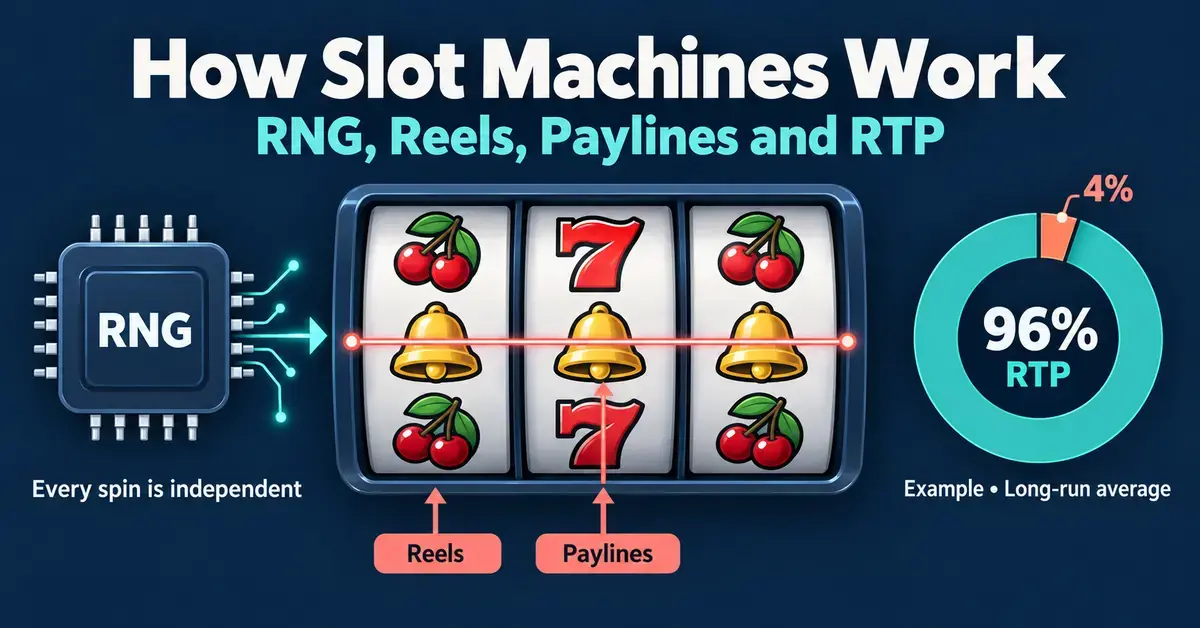
A slot machine is a computer that turns your bet into a random result and then displays that result as spinning reels. Behind the lights, sound and animation, every modern slot — whether it is a cabinet on a casino floor in Canada or a game on a provincially licensed website — is driven by software that selects each outcome at random. This guide explains how that software works, what reels, paylines and return to player (RTP) actually mean, how a game’s odds are set, who tests the machines in Canada, and why popular beliefs about “hot”, “cold” or “due” machines do not hold up.
Key Points
- Software, not luck of the reels: a random number generator (RNG) picks each outcome; the spinning reels only display a result that is already decided.
- Every spin is independent: the machine has no memory, so no spin is ever “due”.
- Symbols are weighted: virtual reels make low-value symbols common and jackpots rare — this sets the odds.
- RTP is a long-run average: e.g. 96% RTP = 4% house edge, measured over millions of spins, not your session.
- No system beats a slot: patterns, “hot” machines and timing tricks do not work.
- Regulated and tested: in Canada, RNGs are certified by provincial regulators or accredited independent labs before machines go live.
What is a slot machine, really?
A slot machine is an electronic gaming machine that accepts a wager, generates a random outcome and pays out according to a fixed set of rules. The reels you see are a display, not a mechanism that decides anything. In older mechanical slots the metal wheels and their physical stops really did determine the result, but today almost every machine — land-based or online — uses graphics on a screen, or motorised reels whose stopping positions are chosen by a computer program.
Because the outcome is produced by software, the “feel” of a spin (the spin button, the clatter, the near-win animation) is entertainment layered on top of a result that has already been decided. Understanding that split — decision first, display second — is the key to understanding everything else below. Slots are one of several game types you will find on a Canadian floor; our casino games explained guide sets them alongside table games and poker.
How does the random number generator (RNG) decide a spin?
A random number generator (RNG) is the piece of software that picks each outcome, and it is the heart of every modern slot. An RNG is an algorithm that produces a continuous stream of numbers with no pattern a player can see or use. It keeps generating numbers constantly, even when nobody is playing the machine.
When you press spin, the game captures whichever number the RNG holds at that exact instant and maps it to a reel position and symbol combination. The result is therefore fixed in a fraction of a second — before the reels finish spinning. The animation simply plays out a result that already exists.
Two consequences follow directly from this design:
- Each spin is independent. The RNG keeps no memory of previous spins, so what happened on the last spin has no influence on the next one.
- Timing cannot be gamed in a meaningful way. The number stream moves far faster than any human reaction, so you cannot “time” a press to force a result.
This is the same principle whether you are playing a physical machine or a licensed online slot. The core difference is who verifies the RNG, which we cover in the regulation section below.
What are reels, symbols and virtual stops?
Reels are the vertical strips of symbols; the result of a spin is the row (or rows) of symbols left showing when they stop. A classic slot shows three reels; many modern games show five or more. But the number of symbols you can see on each reel is not the same as the number of positions the software actually uses.
Modern slots use virtual reels. The program maps the random number to a list of “stops” that is usually much longer than the strip you see — a reel might display, say, 22 symbols yet carry 64 or more computer stops behind the scenes. Each stop is given a weight, and those weights decide how often each symbol appears in the result.
This weighting is why symbols are not equally likely:
- Low-value symbols (cherries, tens, jacks) are weighted to land often, so small wins feel frequent.
- High-value symbols and jackpot symbols are weighted to land rarely, so big wins are scarce.
- A symbol can appear only once on the visible strip yet be far rarer (or more common) than it looks, because several numbers in the stream may map to the same low-value stop while only one maps to the jackpot.
Adjusting these weights is how a designer tunes a game’s payout rate. The maths is set in the software and does not change based on how much you bet or how long you have played.
What are paylines and “ways to win”?
A payline is a specific pattern across the reels that pays when matching symbols land on it. The original slots had a single horizontal payline through the centre. Today a game may offer many lines — across, diagonally or in zig-zags — and these lines are usually invisible until a win is drawn on screen.
Some newer games drop fixed paylines entirely and use a “ways to win” system, where any matching symbols on adjacent reels (from the leftmost reel) pay, regardless of their exact row. A game advertised as “243 ways” or “1,024 ways” is using this model.
Two points matter for a beginner:
- More paylines means more chances to hit a combination, but also a larger total stake, because you are usually betting on every active line at once.
- Paylines do not change the house’s long-run edge. The payout rate is built into the symbol weighting, not into how many lines you play.
What is RTP (return to player)?
RTP, or return to player, is the percentage of all money wagered that a slot is designed to pay back to players over the long run. A game with 96% RTP is built to return about $96 for every $100 staked across millions of spins — and to keep roughly $4 as the house edge. RTP and house edge are simply two ways of describing the same number: a 96% RTP is a 4% house edge.
Three things are essential to understand about RTP:
- It is a long-run average, not a session prediction. Over any single visit you might win, break even or lose far faster than the percentage suggests. RTP only emerges over a very large number of spins.
- It does not change with your bet size or the number of paylines you play.
- Volatility is separate. Two games can share the same RTP yet feel completely different: a low-volatility slot pays small wins often, while a high-volatility slot pays rarely but larger. Volatility describes the pattern of wins; RTP describes the long-run total.
Typical figures, with the caveat that individual machines in Canada rarely display their RTP: land-based slots commonly run somewhere around 85%–98%, often toward the lower end on penny machines; online slots frequently sit around 95%–97%, with the figure sometimes shown on the game’s info screen. Older British Columbia Lottery Corporation procurement rules required machines to return no lower than 75%. Because the house always keeps a margin, slots are not a way to make money — a point our guide to how casino games work makes for every game on the floor.
Key Terms
| Term | What it means | Typical range / note |
|---|---|---|
| RNG (random number generator) | Software that selects each spin’s outcome at random | Runs constantly; no memory of past spins |
| RTP (return to player) | Long-run share of wagers paid back to players | Often ~95–97% online; ~85–98% land-based |
| House edge | The casino’s long-run margin — the mirror of RTP | 96% RTP = 4% house edge |
| Volatility (variance) | How often and how large wins tend to be | Low = frequent small wins; high = rare large wins |
| Payline / ways to win | The pattern(s) matching symbols must land on to pay | From 1 line to hundreds or “243/1,024 ways” |
How are a slot’s odds and payouts set?
A slot’s odds come from a document called a par sheet, which the game’s maker uses to define every reel stop, its weight and the resulting payout. The par sheet lists how many stops each symbol gets on each reel, the prize for each winning combination, and the theoretical “hold” (the share of wagers the machine is expected to keep). Put simply: the designer chooses a target payout percentage, then sets the symbol weights so the maths works out to that figure over the long run.
A worked illustration from public patent and training material: a three-reel game with 64 stops per reel has 64 × 64 × 64 — 262,144 — possible combinations. The chance of any particular combination is just how many of those outcomes produce it, divided by the total. Because the weighting is fixed in software and certified before the machine is used, the odds are the same on your first spin and your thousandth.
This is also why you cannot read anything into a machine’s recent history. The combinations are drawn from the same fixed distribution every time, like rolling the same loaded dice over and over.
Do slot machines have patterns, or get “due” to pay?
No — slot machines do not follow patterns and are never “due” for a payout. This is the single most important myth to retire. Because each spin is independent and drawn from the same fixed odds, a machine that has not paid in hours is exactly as likely to pay on the next spin as one that just hit a jackpot.
The belief that a result is “owed” after a losing streak is a textbook example of the gambler’s fallacy — the mistaken idea that past random events change future ones. It is the same error as expecting “tails” to become more likely after three “heads” in a row. The coin, and the slot, have no memory.
A few related beliefs, and what the evidence says:
- “Hot” and “cold” machines. There is no mechanism for a machine to enter a paying or non-paying streak; short runs are ordinary variance, visible only in hindsight.
- Near misses. When two jackpot symbols land and a third stops just above or below the line, that is a weighted display outcome, not a sign you are close. Research, including a University of Alberta study and a review in the Journal of Gambling Studies, found no reliable evidence that near misses actually increase how much people play, though they can trigger a physical response.
- Time of day, loyalty cards or bet size “unlocking” wins. None of these change the RNG’s fixed odds.
Because the odds cannot be shifted in the player’s favour, no system, pattern or app can make slots beatable over time.
Who tests and regulates slot machines in Canada?
In Canada, gambling is conducted and managed by the provinces, and each province’s regulator is responsible for making sure slot machines are fair before they reach the public. The way gambling is regulated in Canada splits responsibility between the Criminal Code and the provinces, so the exact body depends on where you play.
Two models are common:
- Land-based machines. In Ontario, the Alcohol and Gaming Commission of Ontario (AGCO) tests electronic gaming equipment through an in-house laboratory accredited to the international ISO 17025:2017 standard, checking integrity, security, fairness and auditability against the Registrar’s technical standards before a machine is approved.
- Online (igaming). For Ontario’s regulated internet market, games and their RNGs must be certified by an Independent Testing Laboratory (ITL) registered with the AGCO — firms such as Gaming Laboratories International (GLI), BMM and eCOGRA — before they can be offered.
Elsewhere, provincial crown corporations such as the British Columbia Lottery Corporation and others operate under their own gaming authorities and testing requirements. The common thread is that a slot’s RNG and payout maths are verified by an accredited party — not by the casino itself, and not left to chance. Operators that deploy untested software can be penalised; in 2025 the AGCO issued a six-figure penalty to an operator for using unapproved gaming software.
What common mistakes do slot players make?
The most common mistake is treating slots as a solvable puzzle rather than a fixed-odds game of chance. Here are the beliefs and habits that most often lead players astray:
- Chasing a “due” machine. Pouring more money into a cold machine on the theory that it must pay soon — it will not become more likely to pay.
- Chasing losses. Increasing bets to “win back” what you have lost, which only increases the amount exposed to the house edge.
- Misreading RTP. Expecting a 96% RTP to mean you lose only 4% in a session. RTP is a long-run figure and says nothing about your afternoon.
- Confusing volatility with generosity. Assuming frequent small wins mean a machine is “loose”; that is just low volatility, not a better deal.
- Buying systems or apps. Any product that claims to predict or beat a certified RNG is selling something that cannot work.
- Playing without a limit. Not setting a time and money budget before starting, so entertainment quietly turns into a loss you did not plan for.
Can you beat a slot machine, and who are slots for?
No strategy makes slots profitable over time, because the house edge is built into the certified odds and every spin is independent. The only variables you genuinely control are which game you play, how much you stake per spin, and how long you play — none of which change the underlying maths in your favour.
That makes slots a form of paid entertainment, best suited to players who enjoy the format, understand that the expected result is a net loss over time, and treat their stake like the price of a night out rather than an investment. If you want games where skill can reduce (though not erase) the house edge, table games are a different proposition, and you can explore where to find both at land-based casinos across Canada.
Responsible Gambling and Disclaimer
This article is for general information only. It is not gambling, legal or financial advice, and nothing here suggests that slots can be beaten or that any pattern, system or “due” machine improves your chances — they cannot and do not.
Slot machines are designed so the house keeps a margin over time; the realistic long-run outcome of play is a loss. The legal gambling age in Canada is 19 in most provinces and territories, and 18 in Alberta, Manitoba and Quebec.
If gambling is no longer fun, or if you are worried about your own play or someone else’s, free and confidential help is available across Canada, along with voluntary self-exclusion and tools such as GameSense. You can find verified provincial help lines and support options through our responsible gambling in Canada resource.
Sources
- Alcohol and Gaming Commission of Ontario — Electronic gaming equipment and systems
- AGCO — Registered Independent Testing Labs
- University of Alberta — Near misses on slot machines may not encourage continued gambling
- Journal of Gambling Studies — The Near-Miss Effect in Slot Machines: A Review
- USPTO — Gaming device with virtual-map driven reel stop position determination (patent)
- University of Arizona (RTIP) — Example slot par sheet
- Government of British Columbia — Directive on BCLC responsible-gambling standards
Frequently Asked Questions (FAQ)
Are slot machines really random?
Yes. Modern slots use a certified random number generator that picks each outcome independently, with no memory of previous spins. In regulated Canadian markets, that RNG is tested by the provincial regulator or an accredited independent lab before the machine is used.
What does RTP mean on a slot machine?
RTP (return to player) is the share of all wagered money a slot is designed to pay back over the very long run — for example, 96% RTP means a 4% house edge. It is a long-term average across millions of spins, not a prediction of what you will win or lose in a single session.
Do slot machines have patterns you can predict?
No. Each spin is drawn from the same fixed odds and is independent of every other spin, so there is no sequence, cycle or pattern to read. Believing a machine is “due” is the gambler’s fallacy and does not reflect how the game works.
Can a machine be “hot” or “due” to pay out?
No. A machine that has gone a long time without paying is exactly as likely to pay on the next spin as one that just hit, because the RNG does not track history. Winning and losing streaks are ordinary variance, visible only after the fact.
Can you improve your odds of winning on slots?
You cannot change the built-in odds of a slot. Choosing a game with a higher published RTP and setting a firm time and money limit are the only sensible steps — and even then the long-run expected result is a loss, so slots should be treated as entertainment, not income.
