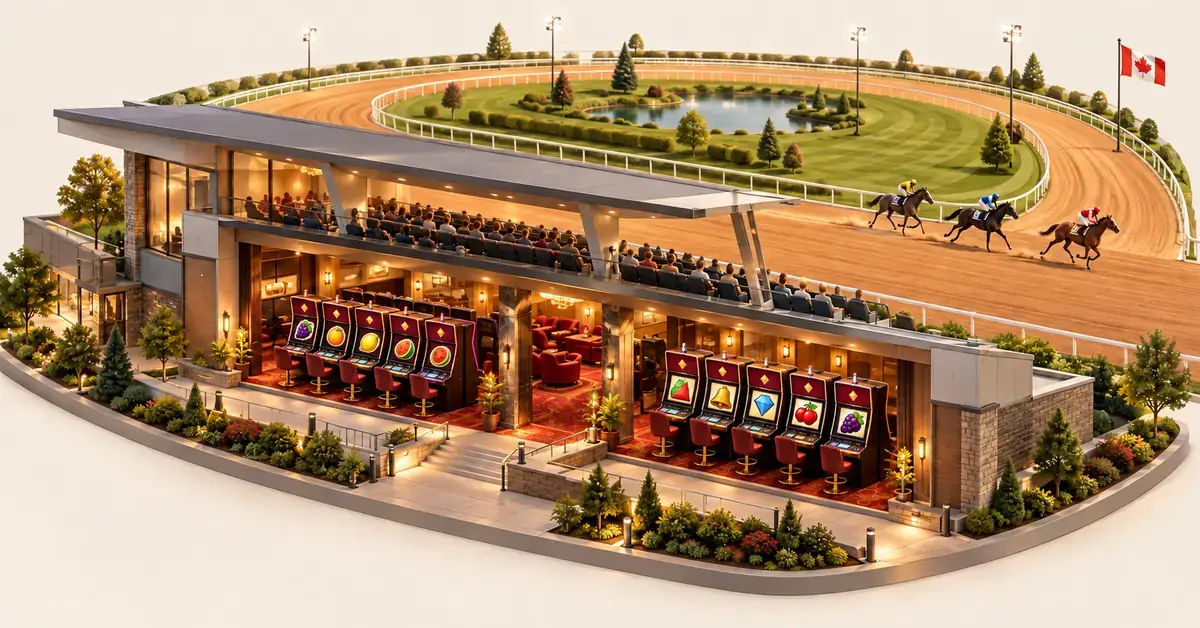
A racino is a single venue that combines a horse-racing track with a casino gaming floor — usually slot machines or video lottery terminals (VLTs), and sometimes electronic or live table games. The word is a blend of “racetrack” and “casino,” and it describes a very specific business model: gaming machines are added to a racecourse so that the gambling revenue helps keep live racing alive. In Canada you will rarely see the word on a sign — venues here are branded as a “Racetrack and Casino” or simply a casino at a racetrack — but the concept is the same one used across the United States, France and elsewhere.
Key Facts
- What it is: a venue combining a horse-racing track with a casino gaming floor (slots, VLTs and sometimes table games).
- The name: a blend of “racetrack” and “casino,” coined in the United States in the mid-1990s.
- Why they exist: to prop up declining horse racing — a share of gaming revenue funds purses and the industry.
- In Canada: true racinos include Alberta’s Century Downs (2015) and Century Mile (2019); Ontario has casinos at racetracks such as Woodbine Mohawk Park.
- Who runs the gaming: the province conducts and manages it — the track hosts the floor, it does not own the slots.
- Minimum age: 18 in Alberta; 19 in Ontario and British Columbia.
What is a racino, exactly?
A racino is a racetrack that also holds a casino licence for its gaming floor. The defining feature is co-location: betting on live and simulcast races happens in the same building as the slot machines, and the gaming operation exists, historically and legally, because the racetrack does. Take away the track and, in most jurisdictions, the authorisation for the machines would not have been granted.
That is the key difference from a stand-alone casino, where gaming is the whole business. At a racino, the slots were introduced as a lifeline for a declining sport. For decades, pari-mutuel wagering — the pooled betting system used in horse racing, where all bets of one type go into a pool and winners share it after the track takes its cut — was one of the few legal forms of gambling. As lotteries and casinos spread, betting on races fell sharply, and purses (the prize money paid to winning horses) shrank with it. Racinos were the industry’s answer: let a track add machines, and use a slice of the proceeds to prop up racing.
How does a racino work?
At a racino, two gambling products run side by side under one roof. Understanding each is the quickest way to see how the model holds together.
The racing side
The track hosts live race meets — most commonly Standardbred (harness) racing in Canada, but also Thoroughbred and Quarter Horse racing at some venues — and takes pari-mutuel bets on those races. It also offers simulcast wagering, meaning you can bet on races broadcast from tracks elsewhere. This is the traditional business, and on its own it rarely covers costs today.
The gaming side
The casino floor is where the money is now made. In Canada that floor is dominated by slot machines and VLTs, with electronic table games and, at larger sites, live tables such as blackjack and roulette. If you want the mechanics, our explainer on how slot machines work covers the random number generator, paylines and return-to-player percentage that apply at a racetrack exactly as they do anywhere else — being next to a racecourse does not change the odds.
Where the gambling money goes
The crucial detail is that the racetrack usually does not simply pocket the slot revenue. In Canada, gambling is conducted and managed by the provinces under the Criminal Code, so the machines at a racetrack are run by (or on behalf of) the provincial lottery-and-gaming authority, not the track company. The venue is paid to host the gaming floor, and a defined share of the proceeds is channelled back into horse racing — funding purses, breeders and the tracks themselves. That revenue-sharing arrangement is the whole point of the racino: casino money subsidising a sport that can no longer fund itself.
Racino vs. casino: what is the difference?
The difference is the racetrack and the strings attached to the gaming licence. A commercial casino is licensed purely to offer gambling; a racino is a racetrack whose gaming floor exists as an add-on tied to live racing. In practice, the games you can play may look identical — the same slot machines, the same house edge — but the legal structure, the ownership of the gaming, and where the profits flow are different.
- Primary purpose: a casino’s business is gambling; a racino’s gaming floor is attached to a racetrack and partly funds racing.
- Licensing link: at a racino the gaming authorisation is tied to holding a racing licence and running race dates.
- Revenue flow: a set portion of a racino’s gaming revenue is directed to horse-racing purses and the industry.
- Game range: racinos historically centred on slots and VLTs; many have since added table games, narrowing the gap with full casinos.
- Atmosphere: a racino pairs a grandstand, paddock and betting windows with a gaming floor and restaurants, rather than a casino-only resort.
The history of racinos
Racinos emerged in the United States in the early 1990s as a rescue plan for struggling tracks. West Virginia authorised video lottery terminals at Mountaineer Park in 1990 as a pilot, written into law in 1994. In 1992, Rhode Island allowed electronic gaming devices at Lincoln Greyhound Park, partly in response to the opening of the Foxwoods casino in neighbouring Connecticut. On 1 April 1995, Iowa’s Prairie Meadows opened a slot casino at its track — one of the venues most often cited when the word “racino” first appears, around the mid-1990s.
The driver everywhere was the same: pari-mutuel wagering had been declining for years as other forms of gambling expanded, and tracks needed a new revenue stream. The model spread across the US over the following decades, and by the end of 2023 roughly 50 racinos were operating in about 17 states (not counting tracks that run only historical horse racing machines, a distinct US product that looks like a slot machine but is legally classed as pari-mutuel betting). Racinos also operate in Canada and France. Canada’s own path to legal racetrack gambling runs through the history of horse racing and lotteries in Canada, where pari-mutuel betting was legalised long before casinos.
Are there racinos in Canada?
Yes — Canada has true racinos and a wider set of racetrack-casino venues, concentrated in Alberta and Ontario. The term is not an official legal category here, so the picture is best understood province by province.
Canadian Racinos Compared
| Venue | Province (area) | Live racing | Gaming operator | Opened / notes |
|---|---|---|---|---|
| Century Downs Racetrack & Casino | Alberta (near Calgary) | Standardbred (harness) | Century Casinos | 2015; ~650 slots plus VLTs |
| Century Mile Racetrack & Casino | Alberta (near Edmonton) | Thoroughbred, Standardbred, Quarter Horse | Century Casinos | 2019; one-mile track, replaced Northlands Park |
| Woodbine Mohawk Park (Elements Casino Mohawk) | Ontario (Milton) | Standardbred (harness) | Great Canadian Entertainment | Slots on site since 1999 |
| Flamboro Downs (Elements Casino Flamboro) | Ontario (Hamilton) | Standardbred (harness) | Great Canadian Entertainment | SARP-era racetrack casino |
| Grand River Raceway (Elements Casino Grand River) | Ontario (Elora) | Standardbred (harness) | Great Canadian Entertainment | SARP-era racetrack casino |
| Rideau Carleton Raceway (Hard Rock Ottawa) | Ontario (Ottawa) | Standardbred (harness) | Hard Rock | Casino at a harness track |
| Fraser Downs (Elements Casino Surrey) | British Columbia (Surrey) | Harness racing ended Aug 2025 | Great Canadian Entertainment | Casino continues; no longer a racino |
Ontario and the Slots at Racetracks Program
Ontario pioneered the Canadian version of the model with its Slots at Racetracks Program (SARP). Launched in 1998, SARP placed provincial slot machines at racetracks and shared the proceeds with the racing industry — at its peak it directed roughly $345 million a year to horse racing. The province cancelled the program in 2012 and it ended on 31 March 2013, a decision the Auditor General later criticised for leaving the industry without a transition plan.
Racing funding was eventually rebuilt through a long-term agreement signed in 2019 and run through the Ontario Lottery and Gaming Corporation (OLG). It makes a large annual sum available to tracks, breeders and horsepeople through 2038 (reported in the range of about $105 million to $120 million a year), and in 2026 the province added a top-up of roughly $35 million a year for five years. Crucially, many Ontario racetracks still have casinos — but under the province’s gaming modernisation, those casinos are now run by private operators rather than the government or the track. Great Canadian Entertainment operates Elements Casino Mohawk at Woodbine Mohawk Park in Milton (slots have been on site since 1999), Elements Casino Flamboro at Flamboro Downs, and Elements Casino Grand River at Grand River Raceway, while Hard Rock operates the casino at Rideau Carleton Raceway in Ottawa. You can see where these fit among the province’s wider venues in our guide to casinos in Ontario.
Alberta’s Century Downs and Century Mile
Alberta is home to Canada’s clearest purpose-built racinos. Century Downs Racetrack and Casino opened on 1 April 2015 in Rocky View County near Calgary, bringing live horse racing back to the Calgary area for the first time since 2008; its casino floor has around 650 slot machines plus VLTs, alongside a Standardbred harness track and off-track betting. Century Mile Racetrack and Casino followed on 1 April 2019, built in Leduc County beside the Edmonton International Airport to replace the historic Northlands Park. Century Mile is a one-mile dirt oval — described as the only “A-level” one-mile track in Western Canada — and hosts Thoroughbred, Standardbred and Quarter Horse racing, including the Canadian Derby.
Both venues are operated by Century Casinos; their underlying real estate was sold to Vici Properties in a 2023 sale-and-leaseback deal, and in September 2026 Century agreed to sell the operating businesses to Highfield Investment Group, with the deal expected to close around the turn of 2027. As in Ontario, a share of the gaming revenue supports horse racing in the province. These sites are listed in our overview of casinos in Alberta.
Other provinces
Elsewhere the racino model is thin and shrinking. British Columbia’s only harness track, Fraser Downs in Surrey, closed on 15 August 2025 after the City of Surrey exercised a lease option; the adjacent Elements Casino Surrey continues to operate, but because live racing has ended there, it is no longer a racino in the strict sense — just a casino on a former racetrack site. That closure is a reminder that the racino is a fragile arrangement: when a track’s racing ends, the casino often survives and the racing does not.
What games can you play at a racino?
At a Canadian racino you can generally bet on races and play the casino floor, though the exact mix depends on the venue and province. Typical offerings include:
- Slot machines and VLTs — the core of the gaming floor and the main source of revenue.
- Electronic table games — terminal-based versions of roulette, blackjack and baccarat.
- Live table games — at larger sites, dealer-run blackjack, roulette and poker, subject to the provincial licence.
- Pari-mutuel race wagering — betting on the live card and on simulcast races from other tracks.
- Dining and entertainment — restaurants, lounges and off-track betting areas round out the venue.
The odds on the gaming floor are governed by the same mathematics as any casino. The house edge on the slots does not improve because the building also hosts horse racing, and no betting system changes it.
Common misconceptions about racinos
The racino is widely misunderstood, partly because the word is used loosely. A few points clear up the most frequent mistakes.
- “Racino” is not an official Canadian term. Operators and regulators here say “racetrack and casino” or “casino at a racetrack.” The label is an industry shorthand, not a licence class.
- The track does not usually keep the slot money. In Canada the province conducts and manages the gaming; the venue is paid to host the floor, and a set share funds racing. The track is a landlord and racing operator, not the casino’s owner.
- Slots at a racetrack are not looser or tighter. Return-to-player and house edge are set the same way as at any casino. Proximity to a racecourse is irrelevant to your chances.
- Historical horse racing machines are a separate US product. Those terminals look like slots but are legally pari-mutuel bets on past races; they are a US phenomenon and not the basis of Canadian racinos.
- A racino is not the same as an online casino or a race-betting app. It is a physical, land-based venue; online wagering is regulated separately.
Who are racinos for?
Racinos suit people who want racing and casino gaming in one trip, and they matter most to the horse-racing industry that depends on their revenue. For a visitor, the appeal is convenience: a day at the track and an evening on the gaming floor without changing venues. For the sport, the appeal is survival — purses, breeding programs and rural racing jobs that pari-mutuel betting alone can no longer sustain. For provinces, racinos are a way to expand regulated gambling while supporting an established industry. As with any gambling venue, the games are built to favour the house over time, so a racino is a place for entertainment on a budget you can afford to lose, not a way to make money.
A note on responsible gambling
This article is general information, not gambling, legal or financial advice. Gambling at a Canadian racino — whether on the races or the gaming floor — always carries risk, and the house holds a mathematical edge on casino games over the long run. The minimum gambling age is 18 in Alberta and 19 in Ontario and British Columbia, and you must be of legal age to enter the gaming floor. If gambling is no longer fun, free and confidential help is available across the country: see our responsible gambling resources and the list of provincial gambling help lines, including ConnexOntario and the support services offered at racetrack casinos themselves.
Sources
- GGB News — Ontario racetrack gaming and Woodbine/Mohawk
- The Lines — Century Casinos sells its two Alberta racinos (2026)
- European Gaming — Century Mile Racetrack and Casino opening announcement
- Ontario Racing — long-term funding agreement and governance
- Auditor General of Ontario — OLG and the Slots at Racetracks Program
- CTV News — Ontario horse-racing funding top-up (2026)
- Canadian Horse Journals — closure of Fraser Downs, B.C. (2025)
- Oregon Legislature — history and impact of racino and historical horse racing machines
Frequently Asked Questions (FAQ)
What does the word “racino” mean?
“Racino” is a blend of “racetrack” and “casino.” It describes a single venue that pairs a horse-racing track with a casino gaming floor, most often slot machines and video lottery terminals. The term appeared in the United States in the mid-1990s.
Are there racinos in Canada?
Yes. Alberta’s Century Downs near Calgary and Century Mile near Edmonton are purpose-built racetrack casinos, and several Ontario racetracks have casinos on site, such as Woodbine Mohawk Park in Milton. The venues are usually called a “racetrack and casino” rather than a racino.
How is a racino different from a regular casino?
A regular casino is licensed purely for gambling. A racino is a racetrack whose gaming floor is tied to holding a racing licence, and a defined share of its gaming revenue is directed back into horse racing. The games themselves can be identical.
Does the racetrack keep the money from the slot machines?
No, not directly in Canada. Because provinces conduct and manage gambling, the slots are run by or for the provincial gaming authority. The track is paid to host the floor, and a set portion of the proceeds funds racing purses and the industry.
What was Ontario’s Slots at Racetracks Program?
It was a program launched in 1998 that placed provincial slot machines at Ontario racetracks and shared the revenue with horse racing. At its peak it sent about $345 million a year to the industry. The province cancelled it in 2012, ending it on 31 March 2013, and later replaced it with a long-term funding agreement.
