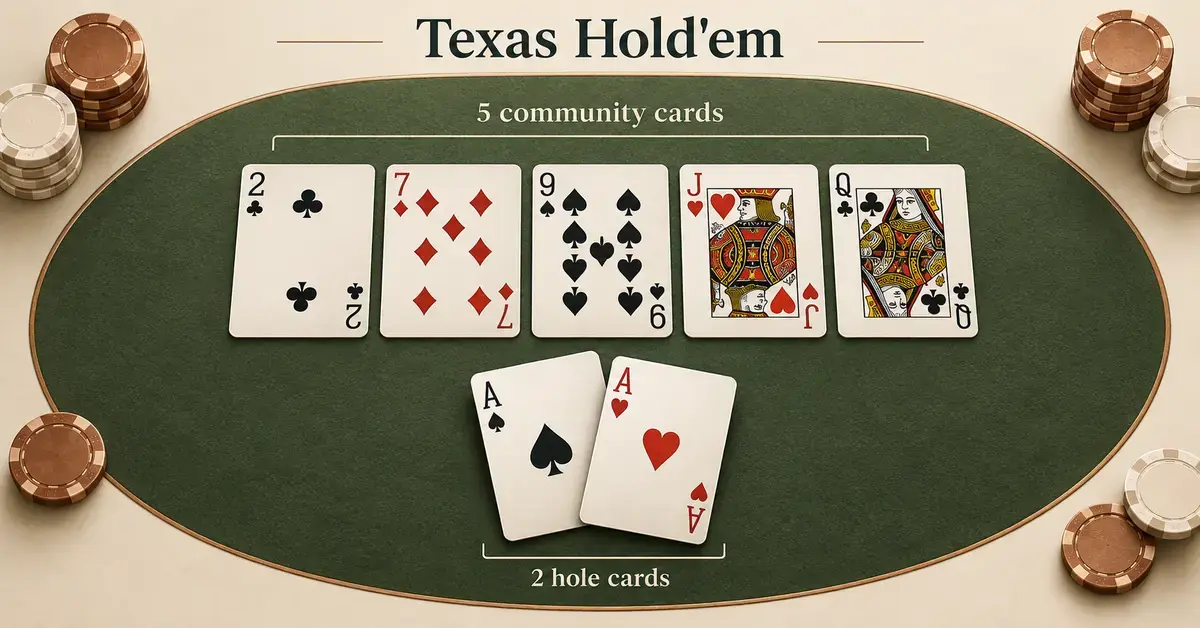
Poker is the one game on a casino floor where you are not playing against the house. In a poker room you compete against the other people at your table, and the casino simply hosts the game and takes a small fee for doing so. That changes almost everything about how you play, how you win and how the venue makes its money. This guide explains how to play poker in a casino from the ground up, using Texas Hold’em — the most common variant in Canadian poker rooms — as the worked example. You will learn the object of the game, how a hand unfolds, the hand rankings, how to buy in, what the rake is, and the etiquette that keeps a table running smoothly.
Key Points
- You play against other players, not the house. The casino earns a small fee (the rake), not a bet against you.
- Texas Hold’em is the standard game in Canadian poker rooms and the easiest to learn.
- Two hole cards, five community cards. The best five-card hand at showdown wins the pot.
- Four betting rounds: pre-flop, flop, turn and river, with the actions check, bet, call, raise and fold.
- You buy in for chips and play “table stakes” — only the chips in front of you are in play.
- Minimum age: 19 in most of Canada, 18 in Alberta, Manitoba and Quebec. Photo ID required.
- Poker is still gambling: skill lowers but never removes the role of chance, and the rake costs money every hand.
How poker in a casino differs from other casino games
In poker you play against the other players, not the dealer. Slots, roulette, blackjack and baccarat are house-banked games: you bet against the casino, and a built-in mathematical advantage — the house edge — means the venue expects to win over time no matter who is at the table. Poker is different. The dealer only distributes cards and manages the pot; the money you win comes from the other players, and the money you lose goes to them.
The casino still earns from the game, but through a fee rather than a bet. In cash games it takes a small percentage of each pot, called the rake; in tournaments it adds a fixed entry fee on top of the prize-pool buy-in. Because the house is not betting against you, poker rewards skill, position and discipline more than the purely chance-based games do — but it is still gambling, the outcome of any single hand turns heavily on the cards, and the rake quietly costs every player money on every hand. If you want the underlying math on how house-banked games compare, see our explainer on the house edge and RTP, and for an overview of the whole floor see casino games explained.
How Texas Hold’em works
Texas Hold’em gives each player two private cards and five shared community cards, and the best five-card hand made from those seven cards wins. It is dealt the same way in almost every casino poker room, so once you understand one hand you can sit down anywhere. Here is the full sequence.
The object of the game
Your goal is to make the best five-card poker hand, or to make everyone else fold before the cards are shown. You build your hand from your two private cards — called hole cards — and the five community cards dealt face-up in the middle of the table. You may use both hole cards, one of them, or neither (“playing the board”); whatever five-card combination is strongest is your hand.
The blinds and the button
Each hand starts with two forced bets called the blinds, which guarantee there is money to play for. A round disc called the button marks the nominal dealer position and moves one seat clockwise after every hand. The player immediately to the left of the button posts the small blind, and the next player posts the big blind, which is usually double the small blind. These are live bets: the player who posted the big blind can still raise when the action comes back around to them.
The four betting rounds
A hand of Hold’em has four betting rounds, each triggered by new cards. The action moves clockwise, and a round ends when every player still in the hand has either matched the current bet or folded.
- Pre-flop: Each player receives their two hole cards. Betting begins with the player to the left of the big blind.
- The flop: Three community cards are dealt face-up. A new betting round begins with the first active player to the left of the button.
- The turn: A fourth community card is added, followed by another betting round.
- The river: A fifth and final community card is dealt, followed by the last betting round.
The betting actions
On your turn you have a small set of choices, and knowing them is most of what you need to play your first hand without hesitating.
- Check: Pass the action without betting — only possible if no one has bet before you in the current round.
- Bet: Put chips in the pot when no one else has yet bet this round.
- Call: Match the amount of the current bet to stay in the hand.
- Raise: Increase the current bet; everyone after you must then call the new amount, raise again, or fold.
- Fold: Give up your cards and forfeit any chips already in the pot. You cannot win the hand, but you lose nothing more.
The showdown
If two or more players are still in the hand after the river betting round, there is a showdown: players reveal their cards and the best five-card hand wins the pot. If a bet on the river goes uncalled — everyone else folds — the last player standing wins without showing their cards. When two hands are exactly equal, the pot is split.
Poker hand rankings
Hand rankings decide who wins at showdown, and they are the same across Texas Hold’em and most common poker variants. Rarer combinations rank higher, which is why a flush beats a straight and four of a kind beats a full house. Memorise the order below before you sit down — it is the single most important thing to know.
Poker Hand Rankings
| Rank | Hand | What it is | Example |
|---|---|---|---|
| 1 | Royal Flush | Ace-high straight flush, all one suit | A-K-Q-J-10 of hearts |
| 2 | Straight Flush | Five cards in sequence, all one suit | 9-8-7-6-5 of clubs |
| 3 | Four of a Kind | Four cards of the same rank | Q-Q-Q-Q-3 |
| 4 | Full House | Three of a kind plus a pair | K-K-K-7-7 |
| 5 | Flush | Five cards of one suit, not in sequence | A-J-8-5-2 of spades |
| 6 | Straight | Five cards in sequence, mixed suits | 8-7-6-5-4 |
| 7 | Three of a Kind | Three cards of the same rank | 5-5-5-K-2 |
| 8 | Two Pair | Two cards of one rank, two of another | J-J-4-4-9 |
| 9 | One Pair | Two cards of the same rank | 10-10-A-7-3 |
| 10 | High Card | No combination; highest card plays | A-Q-9-5-2 |
When two players hold the same type of hand, the higher cards break the tie. A pair of kings beats a pair of tens; if the pairs match, the highest remaining card (the kicker) decides it. Suits have no value in standard poker — there is no “best” suit.
How to join a poker game in a casino
Getting into a game is simpler than it looks. Poker rooms are usually a separate area of the casino with their own desk. Here is the typical process from walking in to playing your first hand.
- Put your name on the list. Tell the desk which game and stake you want (for example “$1/$2 No-Limit Hold’em”). If no seat is free you will be called when one opens.
- Buy in for chips. You can usually bring cash to the table or buy chips at the cashier (the “cage”). Each game has a minimum and maximum buy-in — often 40 to 100 times the big blind.
- Take your seat and wait for the blinds. You either wait for the big blind to reach you or “post” a blind to be dealt in immediately.
- Play within table stakes. You can only wager the chips in front of you on a given hand. You cannot reach for your wallet mid-hand, and you cannot remove chips from the table while you are still in the game.
Minimum ages apply before you ever reach the table. The legal gambling age is 19 in most of the country and 18 in Alberta, Manitoba and Quebec; the full breakdown is in our guide to the legal gambling age in Canada. Bring government-issued photo ID, because poker rooms check it.
Cash games versus tournaments
There are two main formats, and they feel very different. In a cash game, chips equal real money, you can join or leave whenever you like, and the blinds stay the same all session. In a tournament, everyone pays the same entry fee for an equal stack of tournament chips, the blinds rise on a timer, and you play until you either lose all your chips or finish high enough to win a share of the prize pool. Cash games suit casual players who want to drop in for an hour; tournaments suit players who want a fixed cost and a long, structured session.
Betting structures: No-Limit, Pot-Limit and Limit
The stake listed for a game also tells you how much you can bet. The three common structures are:
- No-Limit: You can bet any amount up to all of your chips (“all-in”) at any time. This is the standard for most Hold’em games.
- Pot-Limit: The maximum bet is the current size of the pot. Common in Omaha, another community-card game.
- Fixed-Limit: Bets and raises come in set increments, with a capped number of raises per round. The pace is gentler and swings are smaller.
What is the rake, and how does the casino make money?
The rake is the fee the poker room charges to host the game, and it is how the casino profits from poker without betting against you. In a cash game the dealer removes a small percentage of each pot — typically up to about 10% — but only up to a fixed maximum per hand, known as the cap. In a tournament the fee is bundled into the entry: a “$100 + $20” tournament means $100 goes to the prize pool and $20 is the casino’s fee.
Caps vary by room and province, and they add up. Reporting on Canadian rooms in 2025 found Ontario cash games raking as much as 10% up to a $20 cap, even at low stakes, while some Quebec rooms cap lower, around $8 to $10. Because the rake comes out of every pot you win, it is a real and recurring cost — one reason poker is not a reliable way to make money, and why experienced players pay close attention to a room’s rake before sitting down.
Poker-room etiquette and common mistakes
Poker has unwritten rules, and breaking them marks you as a beginner faster than any misplayed hand. Most of them exist to keep the game fair and moving.
- Act in turn. Wait for the action to reach you; acting early gives other players information.
- Keep your cards and chips visible. Protect your hole cards but do not hide them, and keep your highest-value chips on top so opponents can see roughly how much you have.
- Announce your action. Saying “call,” “raise” or “fold” avoids confusion, and a stated action is binding.
- Do not splash the pot. Place your bet neatly in front of you rather than tossing chips into the middle.
- One player per hand. Do not discuss a live hand or ask for advice while it is in progress.
- Tip the dealer. It is customary to tip a dollar or two after winning a pot, though it is not mandatory.
Common beginner mistakes
Beyond etiquette, a handful of strategic errors cost new players the most. The biggest is playing too many hands — strong players fold the majority of their starting cards. Close behind is ignoring position: acting later in the betting order is an advantage because you see what others do first. New players also tend to call too much and raise too little, chase weak draws, misread the board (for example, missing that the community cards make a possible straight or flush for an opponent), and — most importantly — play with money they cannot afford to lose. Set a budget before you sit down and treat it as the cost of entertainment, not an investment. For broader floor manners, see our guide to casino etiquette and what to expect on your first visit.
Where can you play poker in Canadian casinos?
Dedicated poker rooms exist in several of Canada’s larger casinos, though not every venue has one, and many smaller casinos offer only slots and house-banked table games. Among the better-known rooms are the Great Canadian Casino Resort Toronto, Casino Niagara in Ontario and River Rock Casino Resort in British Columbia, and larger venues periodically host major tournament series. Because poker rooms open, close and change their schedules, it is worth phoning ahead or checking a venue’s website for live hours and stakes before you travel. You can find venues by region in our guide to land-based casinos in Canada.
Is casino poker right for you?
Casino poker suits players who enjoy a slower, social, skill-influenced game and are comfortable making decisions under uncertainty against other people. If you prefer fast, solo play with no bluffing and simple rules, a house-banked table game such as blackjack or baccarat may fit you better. Whichever you choose, remember that poker is still gambling: the rake guarantees the house its share, most players lose over time, and skill reduces but never removes the role of chance. Play for entertainment, with money you can afford to lose.
Responsible gambling
Poker is a form of gambling and carries real financial risk. No amount of skill, strategy or experience guarantees a profit, and the rake means the game costs money to play even when you win pots. Set a firm budget and time limit before you start, never chase losses, and never gamble with money meant for essentials. The minimum legal age is 19 across most of Canada and 18 in Alberta, Manitoba and Quebec.
If gambling is causing harm to you or someone you know, free and confidential help is available. See our responsible gambling resources and the full list of gambling help lines in Canada. In Ontario you can reach ConnexOntario at 1-866-531-2600, 24 hours a day. This article is for general information only and is not gambling, legal or financial advice.
Sources
Frequently asked questions (FAQ)
Do you play poker against the dealer in a casino?
No. In a poker room you play against the other players at your table, and the dealer only distributes the cards and manages the pot. The money you win comes from other players. This is different from “casino poker” table games such as Three Card Poker or Caribbean Stud, which are house-banked and played against the dealer.
How much money do I need to play poker in a casino?
Each game lists a minimum buy-in, often 40 to 100 times the big blind. A small-stakes No-Limit game such as $1/$2 typically needs a buy-in of roughly $100 to $300. Only ever bring money you can afford to lose, and treat the buy-in as the cost of your entertainment.
What is the easiest poker game for beginners?
Texas Hold’em is both the most widely available and one of the easiest to learn, because each player gets only two private cards and the rest are shared. Fixed-Limit games move more gently and keep the bet sizes small, which many beginners find less intimidating than No-Limit.
What does the rake mean and does it affect my winnings?
The rake is the fee the poker room takes from each cash-game pot, usually a small percentage up to a fixed cap, or a fixed fee added to a tournament entry. It comes out of the money on the table, so it reduces what winners actually take home and is a recurring cost on every hand.
What is the legal age to play poker in a Canadian casino?
The legal gambling age is 19 in most provinces and territories, and 18 in Alberta, Manitoba and Quebec. The age that applies is the one where the casino is physically located, and you will need government-issued photo ID to enter the poker room.
