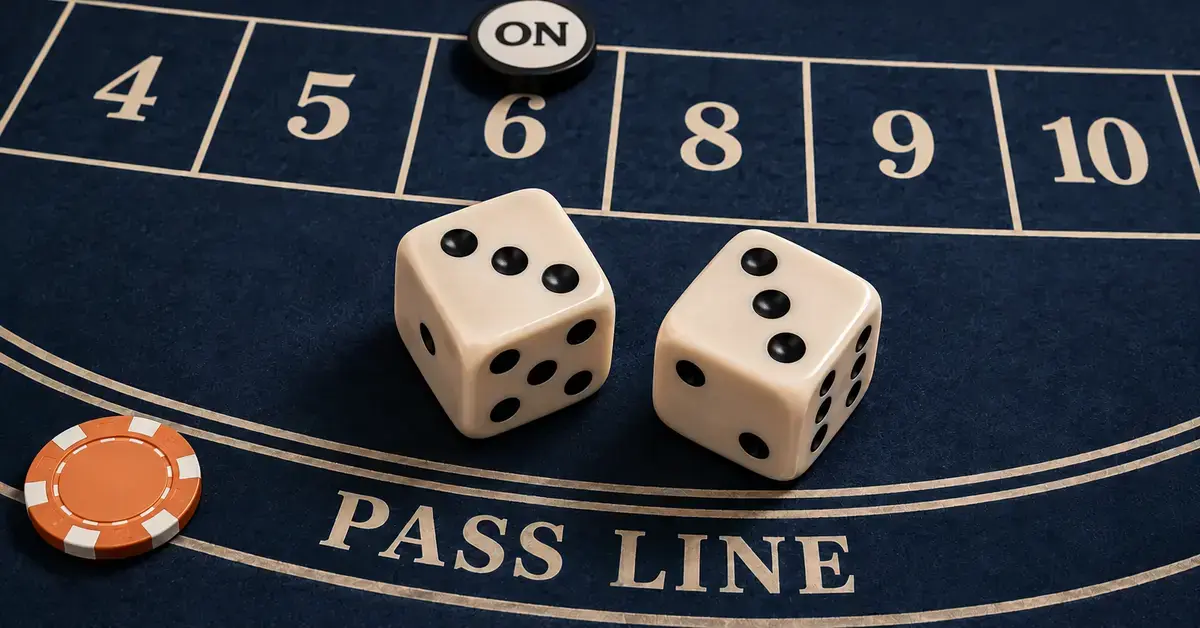
Craps is a dice game in which players bet on the outcome of a roll — or a series of rolls — of two six-sided dice. It has a reputation for looking complicated, with a crowded table and dozens of betting options, but the core of the game rests on a handful of simple rules. This guide explains how a round of craps works, what each main bet pays, where the house edge comes from, and why a small number of bets cost far less to make than the rest. As with every casino game, the odds are built to favour the house over the long run, and no betting system changes that.
Key Facts
- Game type: Dice table game played with two six-sided dice
- Core bet: Pass Line, resolved over a come-out roll and a point phase
- Lowest house edge: Free odds (0%); Pass Line about 1.41%, Don’t Pass about 1.36%
- Highest house edge: Any Seven, at about 16.67%
- Typical top payout: 2:1 on free odds for a 4 or 10; up to 9:1 on hard 6 or 8
- Legal age in Canada: 19+, or 18+ in Alberta, Manitoba and Quebec
What is craps and how does a single round work?
Craps is played with two dice, and one player at a time — the “shooter” — throws them, while everyone at the table can bet on the result. A round is built around the simplest wager on the layout, the Pass Line bet, and unfolds in two phases: the come-out roll and the point phase.
The shooter starts with the come-out roll. If the two dice total 7 or 11, Pass Line bets win immediately. If they total 2, 3 or 12 (called “craps”), Pass Line bets lose. Any other total — 4, 5, 6, 8, 9 or 10 — becomes “the point.”
Once a point is set, the game moves to the point phase. The shooter keeps rolling until one of two things happens: they roll the point number again, in which case Pass Line bets win; or they roll a 7 first (a “seven-out”), in which case Pass Line bets lose and the dice pass to the next shooter. The round can last one roll or many. That rhythm — come out, set a point, chase it before a 7 appears — is the whole engine of the game.
What happens on the come-out roll versus the point phase?
The come-out roll and the point phase reward the opposite numbers, which is the single most important thing a beginner needs to grasp. On the come-out, 7 is a winner for the Pass Line. During the point phase, 7 is the enemy — it ends the round and clears most bets on the table. The same number flips from friend to foe the moment a point is established.
This is why the dice carry so much tension once a point is set: every roll that is not the point and not a 7 simply keeps the round alive. Players can add or remove many bets between rolls, which is part of why the table looks busy. The shooter continues until they seven-out, at which point a new shooter takes over and a fresh come-out roll begins.
What are the main bets in craps?
Craps offers two broad families of bets: “line” bets that follow the shooter through a full round, and single-roll or standing bets placed on specific numbers. Below are the ones you will actually see most players use, from the cheapest to the most expensive in terms of house edge.
Pass Line and Don’t Pass
The Pass Line is the main bet and the one new players should start with. You place it before the come-out roll and win even money (1:1) if the shooter wins the round, as described above. It carries a house edge of about 1.41%. The Don’t Pass bet is its mirror image: you are betting the shooter will seven-out before making the point. It wins even money and has a slightly lower edge of about 1.36%, because the 12 on the come-out is a push (a tie) rather than a win, which keeps the house from gaining the full advantage.
Come and Don’t Come
Come and Don’t Come bets work exactly like Pass and Don’t Pass, but you make them after a point is already set. The next roll acts as a personal come-out roll for that bet, giving it its own point. They let a player have several numbers working at once, and they carry the same low edges — 1.41% for Come and 1.36% for Don’t Come.
Free odds — the only fair bet on the table
After a point is set, a Pass Line or Come bettor can back it with an “odds” bet, often called “free odds.” This is the one wager in the casino that pays true odds and carries a house edge of 0%. It pays 2:1 on points of 4 or 10, 3:2 on 5 or 9, and 6:5 on 6 or 8 — the exact mathematical likelihood of each. Casinos cap how much you can put behind the line, commonly “3-4-5x” (up to three times your Pass bet on 4/10, four times on 5/9 and five times on 6/8). Taking odds lowers your combined house edge because you are adding money to a bet the house makes nothing on.
Place bets
A Place bet lets you wager that a specific number (4, 5, 6, 8, 9 or 10) will be rolled before a 7. The cost varies sharply by number: Place 6 or 8 pays 7:6 for a modest 1.52% edge, Place 5 or 9 pays 7:5 for 4.00%, and Place 4 or 10 pays 9:5 for 6.67%. The 6 and 8 are the sensible choices here; the 4 and 10 are among the pricier standing bets.
Field, Big 6/8 and proposition bets
These are the flashy bets in the centre and around the edge of the layout, and they are the most expensive. The Field is a one-roll bet that wins on 2, 3, 4, 9, 10, 11 or 12 and loses on 5, 6, 7 or 8; it usually pays even money (with 2 and 12 paying 2:1) for a 5.56% house edge. Big 6 and Big 8 pay even money for a 9.09% edge — far worse than placing the same numbers. The centre “proposition” bets are the worst value of all: Any Craps carries an 11.11% edge, the hardways run 9.09% (hard 6/8) to 11.11% (hard 4/10), and Any Seven is the single worst bet on the table at 16.67%.
Bet Comparison
| Bet | Pays | House edge |
|---|---|---|
| Don’t Pass / Don’t Come | 1:1 | ~1.36% |
| Pass Line / Come | 1:1 | ~1.41% |
| Free odds (behind Pass/Come) | True odds: 2:1 (4/10), 3:2 (5/9), 6:5 (6/8) | 0.00% |
| Place 6 or 8 | 7:6 | ~1.52% |
| Place 5 or 9 | 7:5 | ~4.00% |
| Field | 1:1 (2:1 on 2 and 12) | ~5.56% |
| Place 4 or 10 | 9:5 | ~6.67% |
| Big 6 / Big 8 | 1:1 | ~9.09% |
| Hard 6 / Hard 8 | 9:1 | ~9.09% |
| Any Craps (2, 3 or 12) | 7:1 | ~11.11% |
| Hard 4 / Hard 10 | 7:1 | ~11.11% |
| Any Seven | 4:1 | ~16.67% |
Which craps bets have the best and worst odds?
The Pass Line, Don’t Pass, Come and Don’t Come bets — especially when backed with free odds — are by far the best value in craps, while the centre proposition bets are the worst. The spread is enormous: a Don’t Pass bet with full odds can push the effective house edge below a quarter of a percent, while the Any Seven bet hands the house more than one dollar in six over time.
The house edge is simply the share of each wager the casino keeps on average over the long run. A 1.41% edge means that, across many bets, the house expects to keep about $1.41 of every $100 wagered on the Pass Line; a 16.67% edge means it expects to keep nearly $17 of every $100 bet on Any Seven. Those percentages do not predict any single roll — the dice have no memory — but they describe reliably what happens over thousands of rolls. Craps can be one of the lowest-edge games in the casino or one of the highest, depending entirely on which bets you choose.
Why are the free odds so important?
Free odds matter because they are the only part of a craps bet the house takes no cut from, so adding them lowers your overall cost of play without changing the rules. Suppose you bet $10 on the Pass Line (1.41% edge) and the point becomes 6. If you add $50 in odds behind it, that $50 is paid at a fair 6:5 and the house edge on the combined $60 drops to roughly 0.3%. The more odds you are allowed and willing to put down, the closer your overall edge creeps toward zero.
This is why experienced players describe craps as a game where you “take the odds.” It is important to be clear about what this does and does not mean: taking odds reduces how much the house expects to win from you over time, but it does not make the game beatable or tilt any individual roll in your favour. Over a long enough session, the small remaining edge still works against you.
Who runs the table and how do you actually place a bet?
A full craps table is run by a crew of up to four casino staff, and most bets are either placed by you or handed to a dealer to position for you. Two “base dealers” stand at each end and handle bets and payouts; a “stickman” in the centre controls the dice with a long stick and calls the rolls and the centre proposition bets; and a seated “boxman” supervises the game and the chips.
You can place Pass Line, Don’t Pass, Come, Don’t Come and Field bets yourself by putting chips in the marked areas directly in front of you. Odds, Place bets and the centre bets are usually given to a dealer to set, because their positions on the layout are specific. If you are unsure, it is normal to tell the dealer the bet you want and the amount and let them place it. Beginners who have never seen a live table may find our guide to casino etiquette and what to expect on a first visit useful before stepping up.
What mistakes do craps players most often make?
The most common mistake is chasing the high-paying proposition bets in the centre of the table, which carry the worst odds in the whole casino. The 7:1 and higher payouts look tempting, but the Any Seven, hardways and Any Craps bets exist precisely because their rare wins are not paid at their true likelihood. A few other frequent errors:
- Ignoring the free odds. Many players bet a large amount on the Pass Line and nothing in odds, which is backwards — the odds bet is the one with no house edge, so skipping it leaves the only fair wager on the table unused.
- Believing in “hot” or “cold” dice. Each roll is independent. A shooter on a long run is not “due” to keep winning, and a cold table is not “due” to turn. Past rolls tell you nothing about the next one.
- Chasing losses. Increasing bets to win back what you have lost does not change the math; it only increases the amount exposed to the house edge.
- Trusting betting systems. No progression or pattern — not the Martingale, not the Iron Cross — removes the built-in edge. Systems rearrange when you win and lose, not whether the odds favour the house.
- Playing the Big 6/8 instead of placing the 6/8. They look the same but pay differently: placing the 6 or 8 pays 7:6, while Big 6/8 pays only even money for a much larger edge.
Who is craps suited to, and where can you play it in Canada?
Craps suits players who enjoy a fast, social table game and are willing to learn a few bet types, and it is available at most larger land-based casinos across Canada. The game is loud and communal — most players at the table are betting the same way and win or lose together — which many people find more engaging than solitary machine play. Those who prefer a slower pace or a simpler set of choices may prefer roulette or blackjack.
Craps tables are found in the bigger casinos in provinces such as Ontario, British Columbia, Alberta and Quebec, though smaller venues may not offer the game at all and some have replaced live tables with electronic versions. Wherever you play, the minimum legal age applies: 19 in most of Canada, and 18 in Alberta, Manitoba and Quebec, as set out in our guide to the legal gambling age by province. Whichever bets you choose, the house keeps its edge over time — craps is entertainment, not a way to make money.
Disclaimer
This article is for general information only. It explains how craps works and the odds behind each bet; it is not gambling advice and does not suggest that any bet, strategy or system can produce a profit. Every bet in craps carries a built-in house edge, and over time the casino wins.
If gambling is affecting you or someone you know, free, confidential help is available across Canada. See our guide to responsible gambling in Canada for provincial help lines, self-exclusion programs and support resources. Please gamble responsibly and only with money you can afford to lose.
Sources
Frequently Asked Questions (FAQ)
Is craps a game of skill or luck?
Craps is a game of chance. The dice outcomes are random and cannot be controlled, so no skill changes the result of a roll. The only real choice that affects your long-run cost is which bets you make — low-edge bets like the Pass Line with odds cost far less than the centre proposition bets.
What is the house edge in craps?
It depends entirely on the bet. The Pass Line is about 1.41% and Don’t Pass about 1.36%, while free odds carry a 0% edge. Place and Field bets range from roughly 1.52% to 6.67%, and the centre proposition bets run from about 9% to 16.67% on Any Seven.
What is the best bet in craps?
The Pass Line or Don’t Pass bet backed with the maximum free odds offers the lowest overall house edge. The odds portion pays true odds and carries no edge, so adding it lowers the average cost of your combined wager closer to zero — though the game still favours the house.
What does “seven-out” mean in craps?
A seven-out happens when the shooter rolls a 7 during the point phase before rolling the point number again. It ends the round, loses Pass Line bets, and passes the dice to the next shooter. On the come-out roll, by contrast, a 7 is an instant Pass Line win.
Can a betting system beat craps?
No. No betting system or progression removes the house edge built into the bets. Systems like the Martingale or the Iron Cross only change the pattern of your wins and losses, not the underlying odds, which always favour the casino over the long run.
