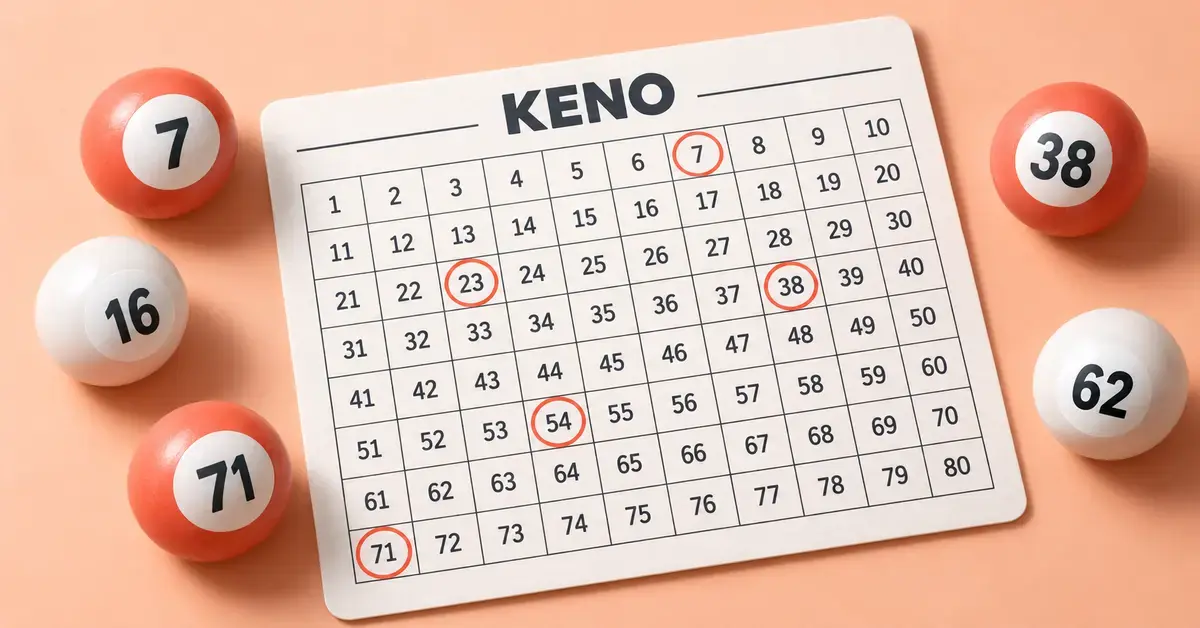
Keno is a casino and lottery game in which you choose a handful of numbers from a grid of 80, the game draws 20 numbers at random, and you are paid according to how many of your picks are drawn. It is one of the easiest games to understand and one of the slowest to lose track of time at, because draws can run every few minutes. It is also, in plain terms, one of the worst-value games on the floor: the amount the house keeps on an average keno bet is far higher than on blackjack, roulette or baccarat. This guide explains the rules, how the numbers are drawn, the real odds of catching your picks, how the payouts and house edge work, the main versions you will meet in Canada, and the mistakes beginners most often make.
Key Facts
- What it is: a number-matching game — pick spots on an 80-number grid, 20 are drawn at random.
- Spots you can play: usually 1 to 10 (some casinos allow up to 15 or 20).
- Numbers drawn: 20 out of 80 every draw.
- Chance any one number is drawn: 1 in 4 (25%).
- House edge: roughly 20%–40% in live and lottery keno; about 5%–16% in video keno.
- Skill involved: none — each draw is independent and random.
- In Canada: run by provincial lottery corporations and licensed casinos; age 19 (18 in AB, MB, QC).
What is keno?
Keno is a number-matching game played on a card of 80 numbers, from 1 to 80. You mark how many numbers you want to play — your “spots” — and the game then selects 20 winning numbers at random. Every number you picked that also appears among the 20 drawn is called a “catch.” The more of your spots you catch, the more you win, based on a published payout table.
The format sits halfway between a lottery and a slot machine. Like a lottery, you pick numbers and wait for a draw; like a slot, each round is fast, fully automated and decided by chance alone. Keno appears in three main settings: as a lounge game in land-based casinos, as a video machine, and as a rapid-draw lottery product sold at retailers. The underlying maths is the same in all of them — only the payout tables and the speed differ. For a broader picture of how the main games fit together, see our overview of how casino games work and the odds behind them.
How to play keno step by step
Playing a single keno ticket takes four steps. The mechanics are identical whether you use a paper slip in a casino lounge, a touchscreen machine or a lottery terminal.
- Choose how many spots to play. Most games let you mark between 1 and 10 numbers; some casinos allow up to 15 or 20. Each number you mark is one spot, so marking six numbers makes it a “6-spot” ticket.
- Pick your numbers. Circle or tap your chosen numbers on the 1-to-80 grid. You can also ask for a “Quick Pick” (the computer chooses for you) — mathematically it makes no difference which numbers you select.
- Set your wager and number of draws. Choose how much to bet per draw and, in lottery keno, how many consecutive draws to enter on the same ticket.
- Wait for the draw and compare. The game draws 20 numbers from the 80. Count your catches and check them against the payout table for the number of spots you played.
That payout table is the part that varies most. Two casinos can run the same 8-spot game and pay very different amounts for the same result, so it is worth reading the table before you hand over money.
How the numbers are drawn
Each keno draw selects 20 numbers from the pool of 80, entirely at random. Live keno lounges traditionally use a glass bubble and numbered balls, exactly like a lottery draw; video and online keno use a random number generator (RNG), the same kind of certified software that decides each spin on a slot machine.
The key fact is that every draw is independent. Numbers that came up last round are no more or less likely to appear this round, and a number that has not been drawn “for a while” is not due. There is no hot or cold number, no pattern to read and no sequence that pays more often. Any single number has a 1-in-4 chance of being among the 20 drawn (20 of the 80 numbers come up each time), and that stays true every draw regardless of history.
Keno odds: how likely are you to catch your numbers?
The chance of catching your numbers falls sharply as you try to catch more of them. Keno odds follow what mathematicians call a hypergeometric distribution — a precise formula based on choosing 20 balls from 80 — so the probabilities are fixed and known. The table below shows a common 10-spot ticket: the odds of catching exactly that many of your 10 numbers.
Odds of Catching Your Numbers
| Numbers caught (10-spot ticket) | Odds (about 1 in) |
|---|---|
| 10 of 10 | 8,911,711 |
| 9 of 10 | 163,381 |
| 8 of 10 | 7,384 |
| 7 of 10 | 621 |
| 6 of 10 | 87 |
| 5 of 10 | 19 |
| 0 of 10 | 22 |
Two things stand out. First, catching all 10 on a 10-spot ticket is about a 1-in-8.9-million shot — rarer than many lottery jackpots. Second, you do not need to catch everything: most keno pay tables also reward partial hits, and on many tables even catching zero of 10 pays a small prize, because missing every number is itself fairly unlikely (about 1 in 22). The payouts for the middle results are modest, which is exactly how the game keeps its edge.
Payouts and the house edge
Keno has one of the highest house edges of any casino game. The “house edge” is the share of every dollar wagered that the operator keeps on average over time; the rest is returned to players as the “return to player” (RTP). You can read a full explanation on our guide to house edge and RTP, but the short version is that the lower the edge, the better the value for the player.
For keno, the edge depends heavily on the venue and the pay table:
- Live casino keno lounges typically keep around 20% to 35% of money wagered — returns of roughly 65% to 80%.
- Video and online keno is usually more generous, often keeping about 5% to 16% (returns around 84% to 95%), though this still varies by machine.
- Rapid-draw lottery keno is run as a lottery and generally sits at the high-edge end, similar to live lounge keno.
To put that in context, here is how keno compares with the other main games covered on this site:
| Game | Typical house edge | Typical return to player |
|---|---|---|
| Blackjack (with basic strategy) | ~0.5% | ~99.5% |
| Baccarat (Banker bet) | ~1.06% | ~98.9% |
| Roulette (single-zero) | ~2.7% | ~97.3% |
| Slot machines | ~2%–10% | ~90%–98% |
| Video keno | ~5%–16% | ~84%–95% |
| Live / lottery keno | ~20%–40% | ~60%–80% |
In other words, a dollar bet on keno is expected to lose many times more than the same dollar bet on blackjack. No choice of numbers, number of spots or betting pattern changes that — the edge is built into the pay table.
How many spots should you pick?
The number of spots you play changes the shape of the game, not its overall value. Playing more spots does not improve your long-run return, because every number carries identical odds and the pay table is set to preserve the house edge whatever you choose. What it does change is the trade-off between frequent small wins and rare large ones.
- Few spots (1 to 4): you win more often, but the prizes are small. A 1-spot ticket hits one in four draws; the payout is correspondingly tiny.
- Many spots (8 to 10 or more): you catch all your numbers very rarely, but the top prizes are large, and partial catches can still pay. This is the “lottery dream” end of keno.
Neither approach is “better” in terms of expected value. Choose based on whether you prefer steady small results or the slim chance of a big one, and set the stake accordingly.
Types of keno
Keno comes in a few distinct forms, and knowing which one you are playing helps you judge its value.
Live casino keno
Played in a dedicated lounge or written on slips and handed to a keno writer, with draws shown on screens around the venue every few minutes. It is relaxed and social, often played while eating or drinking, but it carries the highest edge.
Video keno
A machine version that looks and behaves like a slot. You tap your numbers, press play and see the draw instantly, round after round. Video keno is faster than lounge keno and usually offers a better return, but the speed means you can place far more bets per hour.
Online keno
The same RNG-based game offered through regulated provincial platforms. Where you can play online legally depends on your province, as explained in our guide to online gambling in Canada; the game itself works exactly like video keno.
Lottery keno
A rapid-draw lottery product sold at retailers, with a draw every few minutes. This is the most common way Canadians encounter keno — it is a close relative of the lottery-style games that were legalised in Canada decades ago.
Keno in Canada
In Canada, keno is run by provincial lottery corporations rather than offered freely by private operators, because only the provinces may lawfully conduct gaming. The clearest example is KENO from the Western Canada Lottery Corporation, sold at lottery retailers in Alberta, Manitoba, Saskatchewan and the three territories.
Under those rules you pick 1 to 10 numbers from 1 to 80, wager $1, $2, $5 or $10 per draw, and can enter from 1 to 99 consecutive draws on one ticket. Draws are held every five minutes throughout the day, 20 numbers are drawn each time, and winnings are capped at $100,000 per ticket per draw no matter how much you wagered. A Quick Pick option lets the terminal choose your numbers. Other provinces and their casinos offer their own keno or keno-style draw games; the format and stakes differ, so always check the local rules.
Wherever you play, the legal gambling age applies — 19 in most provinces and 18 in Alberta, Manitoba and Quebec — and the game is only legal through a provincially licensed operator.
Common keno mistakes
Most keno mistakes come from misreading the game as something it is not. The game is pure chance with a steep edge, and the following errors cost players money or create false expectations.
- Chasing “hot” or “cold” numbers. Past draws tell you nothing about the next one. Tracking sheets and frequency charts do not improve your odds.
- Thinking a Quick Pick is worse (or better) than choosing yourself. Every combination has the same probability; how you pick is irrelevant to the result.
- Ignoring the pay table. The same spot count can pay very differently between games. Not checking the table means not knowing the value of the bet you are making.
- Underrating the speed. Draws every few minutes — and instant video rounds — mean many more bets per hour than a table game, so losses add up faster than they feel like they should.
- Buying “systems” or lucky-number services. No strategy, app or system changes a fixed house edge. Anything promising a reliable way to beat keno is false.
A short history of keno
Keno traces back to a Chinese lottery game and was brought to North America by Chinese immigrants in the 19th century, many of them working on the railroads. Early versions used written characters rather than numbers and were known as the “Chinese lottery.”
When Nevada legalised gambling in the early 1930s, lotteries were still banned, so operators rebranded the game as “Race-Horse Keno”: each number stood in for a horse and each draw was called a race, dressing a lottery up as a betting game to sidestep the law. The “racehorse” label was later dropped, and the game settled into the numbered 1-to-80 form played today. (Historical accounts differ on exact dates, so treat specific years with caution.)
Who keno suits
Keno suits players who want a simple, low-effort game of pure luck and treat the stake as the cost of entertainment, not an investment. If you enjoy the lottery-style wait for a draw and do not mind a high house edge in exchange for the chance of an outsized win on a small bet, keno delivers that experience.
It is a poor fit for anyone focused on value or stretching a bankroll, who would do far better at a low-edge game played with a clear head. It is never a way to make money: over time the maths guarantees the operator keeps its share.
A note on responsible gambling
Keno is a game of chance with one of the highest house edges in the casino, and no skill, system or number-picking method can change that. It should be treated as paid entertainment with money you can afford to lose, never as a source of income or a way to recover past losses. Set a budget and a time limit before you start, and stop when you reach either.
If gambling is causing you or someone you know harm, free and confidential help is available across Canada. See our guide to responsible gambling in Canada and the list of provincial gambling help lines. This article is for information only and is not gambling, legal or financial advice.
Sources
Frequently asked questions (FAQ)
How many numbers can you pick in keno?
Most keno games let you choose between 1 and 10 numbers, called spots. Some casino versions allow up to 15 or 20. Whatever you pick, the game then draws 20 numbers from the pool of 80 and pays you based on how many of yours it catches.
What are the odds of winning at keno?
The odds depend on how many spots you play and how many you need to catch. On a 10-spot ticket, catching all 10 is about 1 in 8.9 million, catching 6 is about 1 in 87, and catching 5 is roughly 1 in 19. Any single number has a 1-in-4 chance of being drawn.
Is there a strategy to win at keno?
No. Each draw is independent and random, so no number, pattern, system or app improves your chances. The house edge is fixed in the pay table, and choosing more spots or your own numbers does not change your long-run return.
Why is keno’s house edge so high?
Keno’s payouts are set well below the true odds of catching numbers, so the operator keeps a large share — often 20% to 40% in live and lottery keno, though video versions can be lower. That is far more than games like blackjack or baccarat, where the edge is around 1% or less.
Is keno legal in Canada?
Yes, where it is run by a provincial lottery corporation or a licensed casino. The Western Canada Lottery Corporation sells KENO at retailers in Alberta, Manitoba, Saskatchewan and the territories, and other provinces offer their own keno or keno-style games. The legal age is 19, or 18 in Alberta, Manitoba and Quebec.
