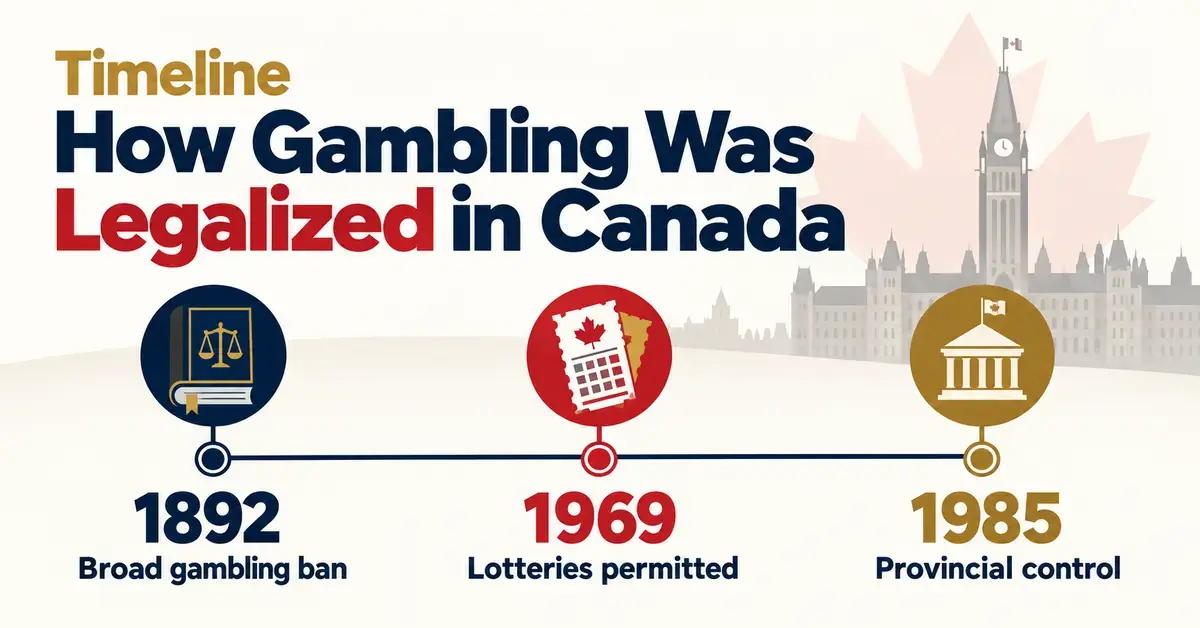
Gambling did not become legal in Canada on a single date. Instead, it was legalized in stages over nearly a century, as Parliament carved narrow exceptions out of a broad 1892 ban and then gradually handed control to the provinces. The two pivotal years are 1969, when a Criminal Code amendment first allowed lotteries and let provinces conduct gambling, and 1985, when the federal government stepped back entirely and left the field to the provinces. This article sets out the full timeline, year by year, and explains what each change actually did.
Key Points
- No single date: gambling was legalized in Canada in stages, not all at once.
- 1892: the Criminal Code bans most gambling, with a narrow racetrack-betting exception.
- 1969: the key turning point — lotteries and government-run gaming become legal.
- 1985: the federal government steps back; provinces gain exclusive control and can run slot machines and VLTs.
- Today: gambling is legal only when a province conducts or licenses it; rules differ by province.
When did gambling become legal in Canada?
There is no one answer, because different forms of gambling became legal at different times. Betting on horse races was the first widely permitted form, formalized in 1910. Legal lotteries and government-run gaming did not arrive until a 1969 amendment to the Criminal Code, and provinces only gained the exclusive right to run and license gambling in 1985. If you need a single turning point, 1969 is the year most historians and legal scholars point to, because it ended the general prohibition that had stood since 1892.
The timeline below shows each major step. For the wider story — how attitudes, religion and politics shaped these laws — see our overview of the history of gambling in Canada.
Timeline
| Year | Change | What it meant |
|---|---|---|
| 1892 | First Criminal Code | Most gambling banned nationwide; only on-track betting at licensed race meetings allowed. |
| ~1900 | Charitable raffles | Small raffles (prizes up to about $50) permitted at church and charity bazaars. |
| 1910 | Pari-mutuel horse racing | Pool betting on horse races formalized at licensed tracks. |
| 1925 | Agricultural-fair games | Certain games of chance allowed at fairs and exhibitions (dice and shell games still banned). |
| 1969 | Lotteries legalized | Criminal Code amendment permits federal, provincial and charitable lottery schemes. |
| 1970 | First provincial lottery | Loto-Quebec holds its first draw on 14 March; Manitoba also launches a game. |
| 1985 | Full provincial control | Federal government vacates the field; provinces gain exclusive authority and reserve slots/VLTs. |
| 2021 | Single-event sports betting | Code amended so provinces can offer betting on a single game or event. |
1892: the Criminal Code bans most gambling
Canada’s first Criminal Code, enacted in 1892, prohibited most forms of gambling nationwide. It pulled together earlier colonial offences against keeping gaming houses, running lotteries and bookmaking, and made them a single federal crime. From this point, running or profiting from games of chance was generally illegal across the country.
The ban was not absolute, however. The 1892 Code kept one narrow exception: betting “on the race course of an incorporated association during the actual progress of a race meeting.” That racetrack carve-out is important, because it is the thread that later becomes legal horse-race wagering. Everything else — casinos, lotteries, private betting houses — fell under the prohibition.
1900: a small exception for charitable raffles
Around the turn of the century, Parliament allowed small raffles run for charitable and religious causes. The exception permitted modest prizes — commonly cited as a value not exceeding $50 — for raffles held at church and charity bazaars. It was the first time fundraising games were tolerated rather than prosecuted.
Sources disagree on the exact year, placing this change at either 1900 or 1901, and the permitted game was a raffle rather than bingo (organised bingo as we know it did not become common until decades later). The practical point is the same: by the early 1900s, gambling for a good cause had a narrow, legal foothold while commercial gambling remained banned.
1910: pari-mutuel betting on horse racing
In 1910, Parliament formalized pari-mutuel betting on horse racing at licensed tracks. Pari-mutuel (from the French pari mutuel, meaning “mutual stake”) is a system in which all bets on a race go into a shared pool; the track takes a fixed cut, and the rest is divided among the winning tickets. Because the odds are set by how the public bets rather than by a bookmaker, it was seen as fairer and easier to regulate.
The 1910 amendment replaced the older betting provisions and limited on-track wagering to events run by incorporated racing associations, capping the number of race days each could hold. For roughly the next 60 years, regulated horse-race betting remained the main form of legal commercial gambling in Canada. (Some records note a further approval of the pari-mutuel system around 1920, refining the 1910 rules.)
1925: games of chance at agricultural fairs
A 1925 amendment created an exemption for games of chance operated at agricultural fairs and exhibitions. Under the change (An Act to Amend the Criminal Code, S.C. 1925, c. 38), the board of a recognized fair — or a concession it licensed on its own grounds — could run certain games while the fair was in progress.
The exemption was limited. It still banned dice games, shell games, punch boards and coin tables, but it allowed wheels of fortune and similar amusements. This carve-out has proved durable: it survives today, in modernized wording, in section 206(3) of the Criminal Code, which still ties the exception to events presenting agricultural or fishing products.
1969: lotteries legalized — the turning point
The single most important change came in 1969, when the Criminal Law Amendment Act, 1968-69 rewrote the Criminal Code’s gambling rules and legalized lotteries for the first time. This is the reform most people mean when they ask when gambling became legal in Canada, and it is the direct legal ancestor of today’s lotteries and casinos.
What the 1969 amendment did
The 1969 amendment allowed “lottery schemes” to be conducted and managed by the federal government or by a provincial government, and allowed provinces to license charities and fairs to run smaller lotteries. In plain terms, it opened the door to large government-run games and put charitable gaming — bingos, raffles and the like — on a clear legal footing instead of the grey area it had occupied for decades.
Why it happened
Several pressures converged. A 1956 parliamentary committee had already found that the old gambling bans were widely ignored and effectively unenforceable, and that there was public support for charitable lotteries. The 1964 launch of a state lottery in New Hampshire renewed North American interest in the idea. In Canada, politicians in Quebec were looking for ways to pay for major projects such as Expo 67 and the coming 1976 Montreal Olympics. Legal lotteries offered a politically acceptable source of public revenue.
The first provincial lotteries
Provinces moved quickly. Quebec created a provincial lottery corporation (Loto-Quebec) and held its first draw on 14 March 1970, making it the first modern provincial lottery in the country; Manitoba also launched a game that year. The federal government ran an Olympic lottery from 1973 and created Loto-Canada in 1976, but the provinces objected strongly to a federal competitor in what they saw as their field — a dispute that set up the next big change.
1985: provinces take full control
In 1985, the federal government agreed to vacate the gambling field entirely, leaving provincial and territorial governments with exclusive authority to conduct and manage lottery schemes. This is the change often called the 1985 gambling amendment, and it is why gambling in Canada is regulated province by province rather than from Ottawa.
VLTs, slot machines and electronic gaming
The 1985 reform also reserved to the provinces the right to operate games on computers, slot machines and video devices. That provision is what later enabled provincial lottery corporations to roll out video lottery terminals (VLTs) and the slot floors of modern casinos. Within a few years, provinces used this authority to license the country’s first legal commercial casinos. For how those venues are spread across the country today, see our guide to land-based casinos in Canada.
How gambling is regulated in Canada today
Today the Criminal Code still makes gambling illegal unless it falls within an exception — and the main exception is gambling conducted and managed by a province. Each province runs its own lottery and gaming corporation, sets its own rules, and licenses charitable and fair gaming within the limits the Code allows. The most recent federal change came in 2021, when Parliament legalized single-event sports betting by amending the Code, again leaving the provinces to decide how to offer it.
In other words, the 1892 ban was never fully repealed; it was hollowed out by a century of exceptions, with the provinces now filling almost all of the space. For a fuller explanation of the current framework, read our guide to gambling laws in Canada.
Common misconceptions about when gambling became legal
A few myths come up repeatedly, so it is worth correcting them directly.
- “Gambling was legalized in one year.” No. It was legalized piece by piece between 1900 and 1985, with 1969 as the decisive step.
- “Casinos have always been legal.” No. Legal commercial casinos only became possible after the 1969 and 1985 amendments; Canada’s first opened in the late 1980s and 1990s.
- “Horse-race betting and lotteries became legal at the same time.” No. Pari-mutuel horse betting was formalized in 1910, nearly 60 years before lotteries in 1969.
- “The federal government runs gambling.” Not since 1985. The provinces conduct and license it; the federal role is limited to the Criminal Code framework.
- “Online gambling became legal in 2021.” What changed in 2021 was single-event sports betting. Provincially run online gaming existed before that under the same provincial-control principle.
A note on this guide
This article is an independent, informational history of Canadian gambling law and is not legal advice. Gambling is age-restricted (19+ in most provinces; 18+ in Alberta, Manitoba and Quebec) and carries financial risk. If gambling is affecting you or someone you know, free, confidential help is available — see our responsible gambling resources for Canada.
Sources
- Law Commission of Canada — The Legalization of Gambling in Canada
- Justice Laws Website — Criminal Code, s. 207 (lottery schemes)
- Justice Laws Website — Criminal Code, s. 206 (games and lotteries)
- The Canadian Encyclopedia — Gambling
- The Canadian Encyclopedia — Lottery
- Colin S. Campbell — Fifty Years of Legal Gambling in Canada (Osgoode Hall Law School)
- The Philanthropist — Charitable Gaming: The Legal Context
- Canadian Museum of History — First provincial lottery in Quebec
Vanliga frågor (FAQ)
When did gambling become legal in Canada?
There is no single date. Horse-race betting was formalized in 1910, lotteries and government gaming were legalized by a 1969 Criminal Code amendment, and the provinces gained exclusive control in 1985. Most historians treat 1969 as the key turning point.
What did the 1969 Criminal Code amendment change?
The Criminal Law Amendment Act, 1968-69 legalized lotteries for the first time, allowed federal and provincial governments to run lottery schemes, and let provinces license charities and fairs to operate smaller games. It ended the general prohibition that had stood since 1892.
Why is 1985 important for Canadian gambling law?
In 1985 the federal government agreed to leave the gambling field, giving provinces exclusive authority to conduct and license lottery schemes. The same change reserved slot machines and video devices to the provinces, which later enabled VLTs and casino gaming.
Was gambling completely banned before 1969?
Almost, but not entirely. The 1892 Criminal Code banned most gambling while allowing narrow exceptions: on-track betting at licensed race meetings, small charitable raffles from around 1900, formal pari-mutuel horse betting from 1910, and games of chance at agricultural fairs from 1925.
When did casinos become legal in Canada?
Commercial casinos only became possible after the 1969 and 1985 amendments gave provinces the power to conduct gaming. The first legal commercial casinos opened in the late 1980s and 1990s, with provinces licensing and operating them under the Criminal Code’s provincial exception.
