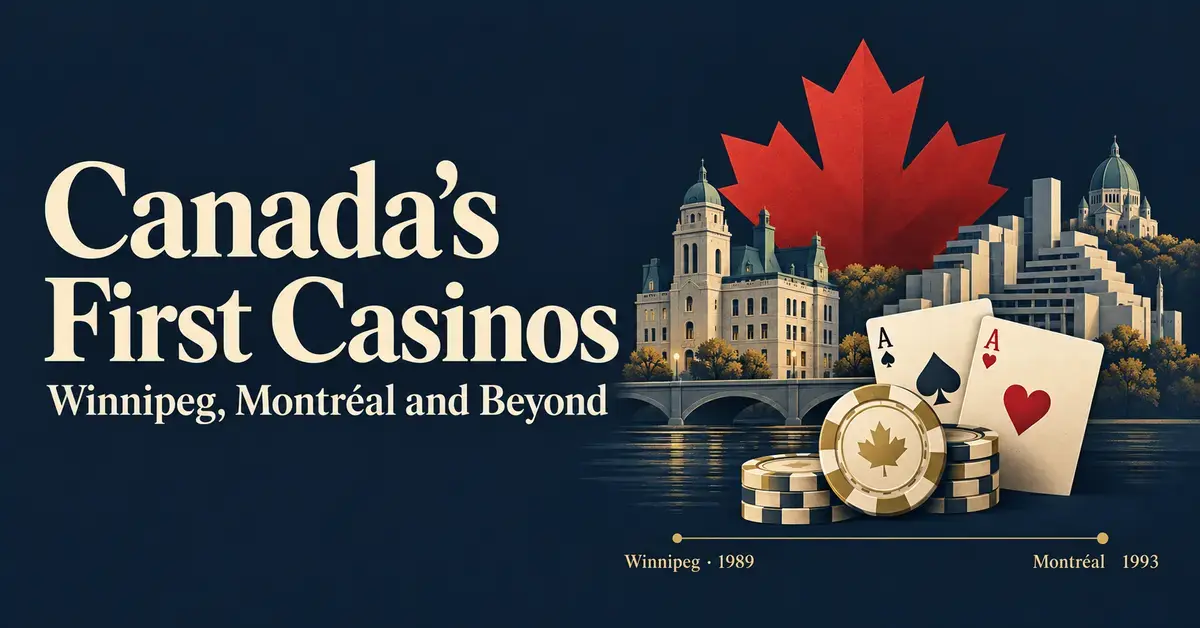
Canada’s first casinos did not all arrive at once, and the honest answer to “which was first?” depends on what you count. Legal casino gambling in the modern sense began with government-run venues in the late 1980s and early 1990s — the Crystal Casino in Winnipeg opened at the end of 1989, and the Casino de Montréal followed in 1993 — but charity-run casinos were already operating in Alberta decades earlier. This guide walks through how casinos became legal in Canada, which venues opened first, and how gaming spread across the provinces. It is part of our wider history of gambling in Canada.
When did Canada get its first casino?
Canada’s first permanent, year-round, government-operated casino was the Crystal Casino, which opened in downtown Winnipeg on December 29, 1989. That is the venue most often described as “the first casino in Canada,” and it is the first of its kind — a continuously operating, province-run casino with slot machines and table games under one roof.
The fuller picture is more layered. Alberta had been licensing charity casinos since the late 1960s, and permanent charity-model casinos opened there in 1980. So Winnipeg’s claim is specifically about being the first government-operated casino, not the first place Canadians could legally gamble in a casino setting. Understanding why that distinction exists means looking at how Canadian law changed.
Key Points
- First government casino: the Crystal Casino, Winnipeg, opened December 29, 1989 — Canada’s first permanent, year-round, province-run casino.
- Earliest legal casinos: Alberta’s charity casinos, from a 1967 event at the Edmonton Exhibition and permanent venues from 1980.
- Québec: the Casino de Montréal opened October 9, 1993 and is the largest casino in Canada.
- Ontario: Casino Windsor opened May 17, 1994; Casino Rama and Casino Niagara followed in 1996.
- Legal basis: the 1969 and especially the December 1985 Criminal Code amendments gave the provinces exclusive control over casinos and slot machines.
The legal road to the first casinos
Casinos could not open in Canada until the Criminal Code made room for them. For most of the twentieth century, gambling was broadly prohibited under federal law, and the shift to legal casinos happened in two decisive steps. You can read the full legal picture in our guide to how gambling is regulated in Canada.
The 1969 Criminal Code amendment
The 1969 omnibus amendment to the Criminal Code was the turning point that first allowed organised gambling. It let federal and provincial governments, along with licensed charitable and exhibition organisations, run “lottery schemes.” In practice this opened the door to government lotteries and to charity gaming events, including early charity casino nights, which had to be licensed by the province.
The 1985 federal–provincial agreement
The second, more important step for casinos came in December 1985. After years of dispute over who controlled gambling, Parliament amended the Criminal Code so that the federal government withdrew from lotteries and the provinces gained exclusive authority to conduct lottery schemes. Crucially, the amendment gave provinces the sole right to operate games on slot machines, video lottery terminals and computers — and barred them from licensing private operators to do so. That single change is what made a modern, slot-filled, government-run casino legally possible. Within four years, Winnipeg had one.
What counts as “first”? Alberta’s charity casinos came earlier
Alberta, not Manitoba, is where legal casino-style gambling in Canada actually began. A charity casino operated at the Edmonton Exhibition in 1967, and it is frequently cited as Canada’s first legal casino. These early casinos ran on a charitable-licence model: private companies supplied and ran the games, but the proceeds went to registered charities and community groups, with the province issuing the licences.
By 1980, Alberta had a permanent casino in this mould — Cash Casino in Calgary — followed by others in Edmonton and elsewhere. Alberta’s charity model remains distinctive to this day, with casino operators sharing gaming proceeds with the charities that staff volunteer shifts on the floor.
The reason Winnipeg still gets called “first” is that the Crystal Casino was the first casino owned and operated by a provincial government agency rather than run privately on behalf of charities. Both statements are true; they simply answer slightly different questions.
The Crystal Casino, Winnipeg (1989): Canada’s first government casino
The Crystal Casino was Canada’s first year-round, government-operated casino, opening on December 29, 1989, inside the historic Hotel Fort Garry in downtown Winnipeg. Run by the Manitoba Lotteries Foundation, it occupied the hotel’s upper floors — a room of slot machines, a room of card games, and a mezzanine for blackjack and baccarat — after the province invested several million dollars to fit it out.
Manitoba Liquor & Lotteries describes it as the first continental-style casino in North America and the first year-round, government-run casino in Canada. It replaced an earlier seasonal operation, the Casino at the Convention Centre, giving Winnipeg a permanent venue for the first time.
The Crystal Casino’s run was relatively short. Its closure was announced in 1997, and it shut its doors in 1999 once two new, larger Winnipeg casinos — Club Regent and McPhillips Station — absorbed its operations ahead of the 1999 Pan American Games. Short-lived though it was, it set the template that other provinces soon copied.
The Casino de Montréal (1993): Québec enters the scene
The Casino de Montréal opened on October 9, 1993, becoming Québec’s first government casino and quickly the largest in the country. The province’s cabinet had approved casino gaming in 1992 and handed the job to Loto-Québec, which created the Société des casinos du Québec to build and operate the venues.
Montréal’s casino was installed in the former France pavilion (with the adjoining Québec pavilion added later) on Île Notre-Dame, a striking leftover of the Expo 67 world’s fair. At launch it offered roughly 65 gaming tables and about 1,200 slot machines, and demand was immediate — more than 780,000 visitors passed through in the first two months alone. If you want to understand the games those visitors were playing, see our explainer on how casino games work.
Québec did not stop at Montréal. The Casino de Charlevoix opened in 1994, and the Casino du Lac-Leamy in Gatineau, across the river from Ottawa, was inaugurated on March 24, 1996. Together they established a provincial network run entirely for public revenue.
First Casinos at a Glance
| Casino | Location | Opened | Operator / model | Notable for |
|---|---|---|---|---|
| Edmonton Exhibition charity casino | Edmonton, AB | 1967 | Charitable licence | Often cited as Canada’s first legal casino |
| Cash Casino | Calgary, AB | 1980 | Charitable licence | Early permanent charity-model casino |
| Crystal Casino | Winnipeg, MB | 1989 | Manitoba Lotteries Foundation | First year-round government casino in Canada |
| Casino de Montréal | Montréal, QC | 1993 | Société des casinos du Québec | First in Québec; largest in Canada |
| Casino Windsor | Windsor, ON | 1994 | Province of Ontario | First casino in Ontario |
| Casino Rama | Rama, ON | 1996 | Ontario / Rama First Nation | Ontario’s first First Nations casino |
The casino boom spreads: Ontario, Alberta and beyond
Once Manitoba and Québec proved the model, casinos spread across Canada in just a few years during the mid-1990s. Each province built its own operator and regulator, so the pace and style varied, but the direction was the same.
Ontario — Windsor (1994), Rama and Niagara (1996)
Ontario’s first casino was the temporary Casino Windsor, which opened on May 17, 1994 in the former Art Gallery of Windsor, directly across the river from Detroit. It was aimed squarely at American visitors, and lineups ran for hours in its early days; a permanent riverfront resort followed in 1998 (today it is Caesars Windsor). Casino Rama, on the lands of the Chippewas of Rama First Nation near Orillia, opened on July 31, 1996 as Ontario’s first First Nations commercial casino, and Casino Niagara opened on December 9, 1996.
Alberta’s permanent casinos continue to grow
Alberta’s charity-licensed casinos kept expanding through the 1980s and 1990s, giving the province one of the densest casino networks in the country under a model unlike any other province’s. The charities that benefit still rotate through volunteer positions on casino floors, a system that traces directly back to Alberta’s 1960s and 1970s roots.
The rest of the country
British Columbia, Saskatchewan, Nova Scotia and other provinces introduced their own casinos through the mid-to-late 1990s, each under a provincial Crown corporation or regulator created after the 1985 Criminal Code change. The result is the patchwork of provincially run and licensed venues you can explore in our guide to land-based casinos across Canada.
Why the early 1990s? What drove the casino boom
Canada’s casino boom was driven by provincial budgets as much as by public demand. After the 1985 amendment handed the provinces exclusive control, casino gaming became an attractive new source of revenue that did not require raising taxes. Governments could run the venues themselves and direct the profits to public programs, health care or charities.
Tourism mattered too. Windsor and Niagara were built to draw American gamblers across the border, and Montréal’s casino became a marquee attraction. Add the proven template from Winnipeg and the popularity of the venues once they opened, and the rapid spread across provinces in the 1990s makes sense.
Common misconceptions about Canada’s first casino
The most common mistake is assuming a single, clean “first casino.” The reality has nuance worth getting right.
- “The Crystal Casino was Canada’s first casino.” It was the first permanent, year-round government-operated casino — but legal charity casinos ran in Alberta from 1967, well before it.
- “The Casino de Montréal was the first in Canada.” It opened in 1993, nearly four years after Winnipeg’s Crystal Casino. It was the first casino in Québec and the largest in Canada, not the first nationally.
- “Casinos were legalised by a single law.” There was no one “casino law.” Casinos became possible through the 1969 and especially the 1985 Criminal Code amendments, then each province decided separately when and how to open venues.
- “Casinos have always been private businesses in Canada.” The early government casinos were run by provincial agencies, and even private-looking venues operate under provincial authority. Private operators cannot run slot machines on their own account.
A note on this guide
This article is a historical and informational overview of how legal casinos first appeared in Canada; it is not gambling advice or an invitation to gamble. Dates and details are drawn from public records, operators and regulators and were verified at the time of writing. Gambling carries real financial risk, and the legal gambling age is 19 in most provinces and 18 in Alberta, Manitoba and Québec. If gambling is affecting you or someone you know, free, confidential help is available through our responsible gambling resources.
Sources
- Manitoba Liquor & Lotteries — Crystal Casino
- CBC News — Manitoba decades in review (Crystal Casino opening)
- Casinos du Québec — Casino de Montréal
- Caesars Windsor — official site
- Ontario Lottery and Gaming Corporation (OLG)
- Alberta Gaming, Liquor and Cannabis (AGLC)
- Canada West Foundation — Gaming and the Public Interest (1969 and 1985 Criminal Code amendments)
Frequently Asked Questions (FAQ)
What was the first casino in Canada?
It depends on the definition. The Crystal Casino in Winnipeg, opened December 29, 1989, was Canada’s first permanent, year-round, government-operated casino. However, legal charity casinos operated in Alberta earlier, with a charity casino at the Edmonton Exhibition in 1967 often cited as the first legal casino in the country.
When did the Casino de Montréal open?
The Casino de Montréal opened on October 9, 1993, in the former France pavilion of Expo 67 on Île Notre-Dame. It was Québec’s first government casino, run by the Société des casinos du Québec, a subsidiary of Loto-Québec, and it remains the largest casino in Canada.
What made casinos legal in Canada?
Two Criminal Code amendments. The 1969 amendment first allowed governments and licensed charities to run lottery schemes. The December 1985 amendment then gave the provinces exclusive authority over gambling, including the sole right to operate slot machines and video lottery terminals, which is what made modern government casinos possible.
Which province opened casinos first?
Alberta was first to license casino-style gambling, through charity casinos from the late 1960s. Manitoba opened the first government-run casino in 1989, Québec followed in 1993, and Ontario opened its first casino in Windsor in 1994, with most other provinces joining in the mid-to-late 1990s.
Is the Crystal Casino still open?
No. The Crystal Casino closed in 1999 after its operations were absorbed by two larger Winnipeg casinos, Club Regent and McPhillips Station, which opened ahead of the 1999 Pan American Games. Winnipeg still has permanent casinos, but the original Fort Garry Hotel venue no longer operates.
