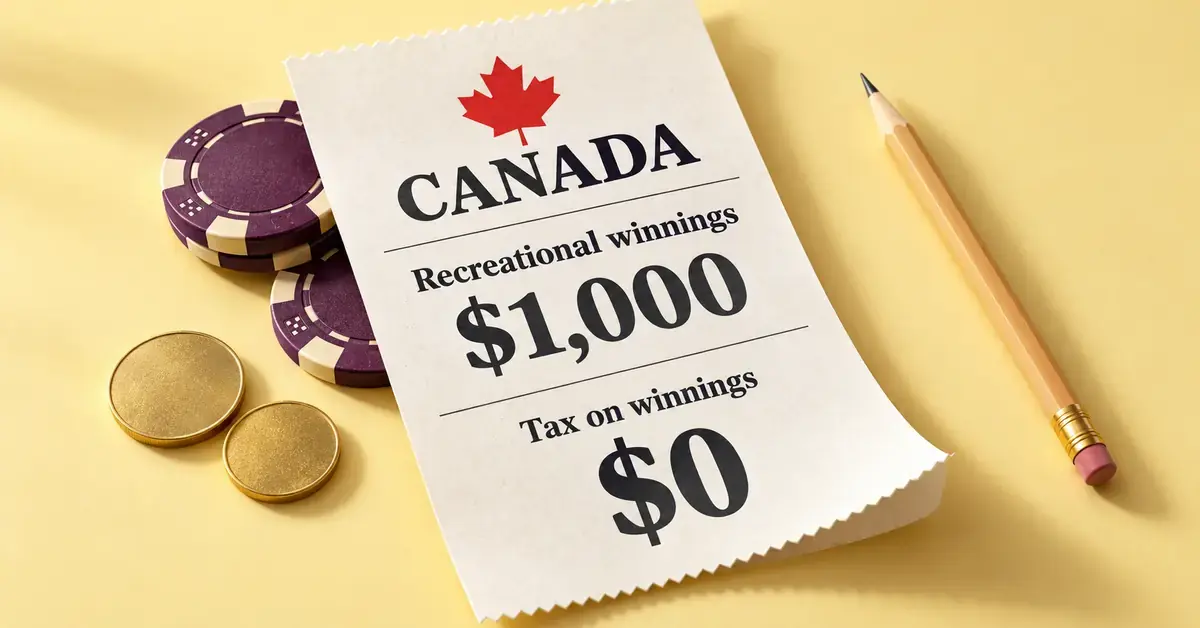
If you hit a jackpot on a Canadian casino slot, win the lottery, or cash out a winning sports bet, the money is almost always yours to keep in full. Canada does not tax the gambling winnings of recreational players — the Canada Revenue Agency (CRA) treats them as a windfall rather than income. There is one important exception for people who gamble as a business, a set of US-specific rules for winnings earned across the border, and a few common misunderstandings worth clearing up. This guide explains exactly when gambling winnings are tax-free in Canada, the narrow cases where they are taxable, and how winnings from the United States are handled.
Key Points
- Recreational winnings are tax-free. Casino, lottery, sports-bet, bingo and raffle wins are treated as windfalls, not income — you keep 100% and report nothing.
- The law deems the gain nil. Paragraph 40(2)(f) of the Income Tax Act sets the gain or loss from a bet or lottery scheme at zero.
- One exception: gambling as a business. Full-time, systematic, profit-dependent players can be taxed on net winnings — and may then deduct losses. It is decided on the facts, not the amount won.
- Income earned on winnings is taxable. The windfall is untaxed, but interest, dividends or capital gains you later earn on it are not.
- US winnings follow US rules. Expect 30% withholding on many wins, partly recoverable under the Canada–US tax treaty.
The short answer: are gambling winnings taxed in Canada?
No — for the vast majority of people, gambling winnings in Canada are not taxable. A recreational player who wins at a casino, buys a winning lottery ticket, places a successful sports or horse-racing bet, or scoops a bingo or raffle prize keeps 100% of the win and does not report it as income. This applies whether you win $20 or $20 million, and whether you play in person or on a provincially regulated website.
The reason is that Canadian tax law views a casual bet as a game of chance that produces a “windfall” — an unexpected gain — rather than income earned from work, a business or an investment. Because it is not income, there is no line on the standard T1 personal tax return for casual gambling winnings, and nothing to declare.
Why Canada treats gambling winnings as a windfall
The legal starting point is that a casual bet is not a source of income under the Income Tax Act, so the gain is simply not taxable. Canada’s income tax system taxes income from identifiable “sources” — employment, business and property (investments) chief among them. A one-off or recreational gambling win does not fit any of those categories, so courts and the CRA have long treated it as a non-taxable windfall.
This is reinforced for betting and lottery play by paragraph 40(2)(f) of the Income Tax Act, which addresses the capital-gains side of the question. It states that a taxpayer’s gain or loss from the disposition of “a chance to win a prize or bet” or “a right to receive an amount as a prize or as winnings on a bet,” in connection with a lottery scheme or a pool system of betting, “is nil.” In plain terms: the law deems the gain to be zero, so there is no capital gain to tax — and, equally, no capital loss to claim. The lottery schemes and betting pools this covers are the ones conducted under the gambling provisions of the Criminal Code of Canada, which is the federal framework that lets provinces run legal gaming.
Does it matter which game or how you win?
For a recreational player the type of game does not change the answer — the win is tax-free either way. The windfall treatment applies consistently across the common forms of legal gambling in Canada:
- Lottery tickets — Lotto 6/49, Lotto Max, provincial draws and scratch cards. The advertised jackpot is what you receive; there is no withholding and nothing to report.
- Casino games — slots, blackjack, roulette, baccarat, craps and the rest. A recreational win is a windfall.
- Sports and horse-race betting — pari-mutuel wagers and single-event sports bets placed with a licensed operator.
- Online gambling — playing on a provincially licensed site is treated exactly like playing in person. Where online gambling is legally offered in Canada, a recreational player’s winnings are not taxed.
- Bingo, raffles and charity draws — prizes are windfalls, not income.
The table below summarises how the main situations are handled.
At a Glance
| Type of win | Taxable in Canada? | Notes |
|---|---|---|
| Lottery jackpot or scratch card | No | Windfall; full amount paid, nothing to report |
| Casino slots or table games (recreational) | No | Treated as a windfall |
| Sports or horse-race bet (recreational) | No | Same windfall treatment |
| Online gambling on a licensed site (recreational) | No | Handled like in-person play |
| Bingo, raffle or charity draw | No | Prize is a windfall |
| Gambling carried on as a business (professional) | Yes | Net winnings are business income; losses deductible |
| Interest or investment income earned on winnings | Yes | Ordinary taxable investment income |
| Winnings earned in the United States | Taxed in the US | ~30% US withholding; partly recoverable via treaty |
| A cash gift of winnings you receive | No | Canada has no gift tax |
When gambling winnings are taxable: the professional gambler
Gambling winnings become taxable only when a person is carrying on gambling as a business rather than as recreation. In that case the net winnings are treated as business income and must be reported, while related losses and reasonable expenses become deductible. This is the single real exception to the tax-free rule, and in practice it affects very few people.
What makes gambling a “business”?
There is no fixed income threshold and no single deciding factor. Canadian courts apply the general business test from the Supreme Court of Canada’s decision in Stewart v. Canada (2002), asking whether the activity is carried on in a sufficiently commercial, businesslike manner with a genuine intention to profit. The CRA and the courts weigh factors such as:
- the degree of organisation and system behind the play;
- the frequency, volume and continuity of the activity;
- whether the person relies on the winnings to make a living;
- the use of skill, training or risk management to produce consistent profit; and
- whether the person treats it like a serious commercial undertaking rather than entertainment.
Notably, whether a game is one of skill or chance is not decisive on its own. Even a skill-heavy game like poker played in a casino is usually a recreational windfall; what matters is the whole picture of how the person conducts the activity.
What the courts have decided
The case law shows how fact-specific this is — large winnings alone do not make someone a professional:
- Leblanc v. Canada (2006) — brothers who wagered tens of millions of dollars on government sports-lottery tickets and profited several million were found not to be carrying on a business, because the underlying game was one of chance and they used no special inside system. Their winnings were not taxable.
- Luprypa v. The Queen (1997) — a skilled pool player who systematically wagered against bar patrons for a steady weekly profit was taxed, because the play was skilful, systematic and profit-driven.
- Cohen v. The Queen (2011) — a poker player who tried to deduct his losses was found not to be running a business, so the losses were not deductible. This cuts both ways: if your winnings are tax-free, your losses give you no tax relief.
- Duhamel v. The King (2022) — a World Series of Poker champion’s winnings of several million dollars were held not taxable, as the court found the play lacked the organised, businesslike character required and retained a strong element of chance.
- Fournier Giguere, Bérubé and D’Auteuil (2022–2023) — by contrast, several poker players who relied on their winnings to fund their lifestyle were found to be carrying on a business and were taxed; the Federal Court of Appeal upheld this approach in 2025.
The thread running through these decisions is whether the person had turned gambling into a consistent, relied-upon livelihood — not simply how much they won or how good they were.
The trade-off: taxable winnings mean deductible losses
Being treated as a professional is not purely a downside, but it is rarely an advantage either. If your winnings are business income, you can deduct your buy-ins, losses, travel and other reasonable expenses against them and report the net figure. A recreational player cannot deduct a single dollar of losses, because those losses are deemed nil under the same rule that makes the winnings tax-free. Most people are far better off as recreational players keeping their full windfall tax-free.
Is interest or investment income on your winnings taxable?
Yes — while the winnings themselves are tax-free, any income you later earn from that money is taxable. This is the most commonly overlooked point. The moment you put a lottery or casino win into a savings account, a GIC, stocks or any other investment, the interest, dividends or capital gains it produces become ordinary taxable investment income, reported like any other.
So a $1 million lottery prize arrives tax-free, but if it earns $40,000 of interest over the following year, that $40,000 is taxable. The original windfall stays untaxed; only the earnings on it are caught. Using a Tax-Free Savings Account (TFSA), within its contribution limits, is one legitimate way to shelter some of those future earnings.
Do you pay tax on gambling winnings won in the United States?
Winnings earned in the United States are taxed under US rules, even for Canadians, and this is where many Canadian players are caught off guard. US casinos generally withhold 30% of certain gambling winnings from non-residents on the spot — for example on slot jackpots of US$1,200 or more — and issue a Form 1042-S showing the amount withheld.
The good news is that Canadians can often recover some or all of that withholding under the Canada–United States tax treaty. The treaty lets a resident of Canada offset US gambling losses against US gambling winnings and be taxed only on the net. To claim a refund you generally need to:
- obtain a US Individual Taxpayer Identification Number (ITIN);
- file a US non-resident return (Form 1040-NR) for the year, attaching the Form 1042-S; and
- keep records of your US gambling losses (tickets, statements, a play diary), since the burden of proof is on you.
Some table games — blackjack, baccarat, craps, roulette and the big-6 wheel — are generally exempt from this non-resident withholding, so tax is usually not held back on those in the first place. Rules and thresholds change, so confirm the current figures and deadlines before filing, ideally with a cross-border tax professional.
Gifts, lottery splits and giving money to family
Giving away part of your winnings does not create a tax bill for you or the person who receives it. Canada has no gift tax, so if you win a jackpot and share it with family or friends, the recipients pay no tax on the cash gift. The same is true of a lottery pool: each member of a legitimate group ticket receives their share as a tax-free windfall. As always, once the recipient invests their share, future income on it is taxable in their hands.
Common mistakes and misconceptions
Several myths lead people to worry about tax they do not owe — or to overlook tax they do:
- “I have to report my casino jackpot to the CRA.” A recreational win is not income and is not reported. Canadian casinos and lotteries do not withhold tax from residents’ winnings.
- “Big wins are taxed, small ones are not.” Size does not change the treatment. A multi-million-dollar lottery jackpot is just as tax-free as a $50 scratch-card win.
- “If I win a lot, the CRA will call me a professional.” The professional test is about businesslike conduct and reliance on the income, not the amount won — as the Leblanc and Duhamel cases show.
- “My winnings grow tax-free forever.” The winnings are tax-free, but interest and investment income earned on them is not. Plan for that.
- “US tax on my Vegas jackpot is gone for good.” Often it is partly recoverable through a US non-resident return under the tax treaty.
- “Online winnings are taxed differently.” They are treated the same as in-person play; legality and taxation are separate questions, and you can read more about how gambling is regulated across Canada.
Who this affects, in practice
The overwhelming majority of Canadians who gamble are recreational players, and for them the rule is simple: keep your winnings, pay no tax, and declare nothing. Only a small number of people — chiefly those who gamble full-time in a systematic, profit-dependent way — fall into the taxable business category, and that status is decided on the specific facts, usually with professional tax advice. If you also gamble in the United States, build US withholding and the treaty-refund process into your expectations.
Disclaimer
This article is general information about how Canadian tax law treats gambling winnings as of 2026. It is not tax, legal or financial advice, and it does not describe your personal situation. Tax rules, case law and US thresholds change, and whether someone is a “professional” gambler is a fact-specific question — consult the Canada Revenue Agency or a qualified Canadian tax professional before acting. Gambling carries financial risk and can become harmful. If gambling is affecting you or someone you know, free and confidential support is available: see our guide to responsible gambling in Canada and the list of provincial gambling help lines.
Sources
- Income Tax Act, section 40 (paragraph 40(2)(f)) — Justice Laws Website
- Criminal Code, lawful lottery schemes (s. 207) — Justice Laws Website
- Taxation of poker winnings and the business test (Fournier Giguere, 2025 FCA 112) — Tax Page
- The Taxation of Poker and Other Gambling Winnings in Canada — Canadian Tax Journal
- Recovering US gambling tax withheld from Canadians — TaxTips.ca
Frequently Asked Questions (FAQ)
Do I have to report casino or lottery winnings on my Canadian tax return?
No. For a recreational player, casino and lottery winnings are non-taxable windfalls, so there is no line to report them on and nothing to declare. Canadian casinos and lottery corporations do not withhold tax from residents’ prizes.
Are online gambling winnings taxed in Canada?
Online winnings are treated the same as in-person winnings. A recreational player who wins on a provincially licensed gambling site keeps the full amount tax-free. The exception — gambling carried on as a business — applies online exactly as it does offline.
Is the lottery really 100% tax-free in Canada?
Yes. You receive the full advertised jackpot with no tax withheld and nothing to report. The only tax arises later: if you invest the money, the interest, dividends or capital gains it earns are taxable investment income.
Do professional poker or sports bettors pay tax on their winnings?
Only if they are found to be carrying on a gambling business — playing in a systematic, commercial way and relying on the income. This is decided case by case using the general business test, not by the size of the winnings. Those who qualify are taxed on net winnings but may deduct losses and expenses.
Can I get back the tax withheld on my winnings in the United States?
Often, yes. US casinos withhold 30% from many non-resident winnings, but under the Canada–US tax treaty you can offset US gambling losses and reclaim some or all of it by obtaining an ITIN and filing a US non-resident return (Form 1040-NR) with your Form 1042-S. Keep proof of your losses.
