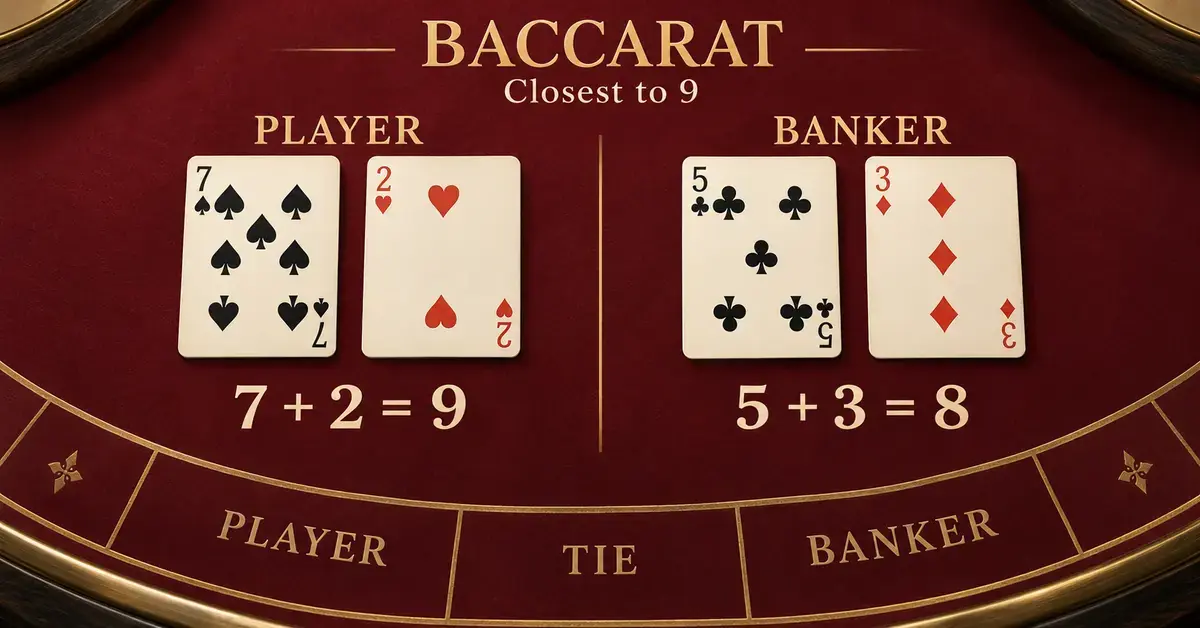
Baccarat is one of the simplest casino table games to play, because almost every decision is made for you by a fixed set of rules. You do not try to build a hand or beat a dealer the way you do in blackjack. Instead you place a single bet — on the Player, the Banker or a Tie — and then watch two hands play out automatically. This guide explains the card values, the three bets, the third-card rule, the real odds behind each wager, and the main variants you will meet in a Canadian casino, all in plain English and with no ‘winning system’ promises, because baccarat is a game of pure chance.
Key Facts
- Game type: Card game of chance (no skill element in standard punto banco)
- Goal: Bet on which hand — Player or Banker — finishes closest to a total of 9
- Your bets: Player, Banker or Tie — placed before any cards are dealt
- Card values: Ace = 1; 2–9 = face value; 10, J, Q, K = 0; only the last digit of a total counts
- Standard payouts: Player 1:1 · Banker 1:1 minus 5% commission · Tie 8:1
- Best bet (lowest house edge): Banker, about 1.06% (8-deck game)
- Worst bet: Tie, about 14.36% house edge at 8:1
- Legal age in Canada: 19, or 18 in Alberta, Manitoba and Quebec
What is baccarat?
Baccarat is a card game in which two hands — called the Player and the Banker — are dealt from a shoe of several decks, and the hand closest to a total of nine wins. Despite the names, you are not dealt a hand of your own and the “Banker” is not the casino’s dealer. They are simply the two sides you can bet on. Your only job is to decide which side you think will win, or whether the two will tie, before any cards are dealt.
The version played in almost every casino in Canada and North America is punto banco, in which the drawing of cards follows fixed rules and no player makes any choices once the bet is placed. Because the outcome is entirely determined by the cards and the rules, baccarat involves no skill or strategy that can change the odds. For a broader look at how table games and their odds work, see our overview of how casino games work and the odds.
The three bets you can make
Before the cards are dealt, you place one bet on the table. There are only three main options:
- Player — betting the Player hand will be closest to nine. Pays even money (1 to 1).
- Banker — betting the Banker hand will be closest to nine. Pays even money, minus a standard 5% commission on wins.
- Tie — betting both hands will finish with the same total. Usually pays 8 to 1.
If you bet on Player or Banker and the round ends in a tie, your bet is not lost — it is returned (a push). The Tie bet only wins when the two hands actually tie, and loses on every other result.
How are the cards counted in baccarat?
Card values in baccarat are counted differently from most games, and this is the first thing to learn. The values are:
- Aces count as 1.
- 2 through 9 count at their face value.
- 10s and all face cards (Jack, Queen, King) count as 0.
A hand’s score is the total of its cards, but only the final digit of that total counts — you drop the tens digit. So a hand of 7 and 6 totals 13, which scores as 3. A hand of a King and a 5 totals 5. A hand of 9 and 8 totals 17, which scores as 7. This means no hand can ever be worth more than nine, and nine is the best possible score. There is no ‘busting’ as there is in blackjack.
Naturals: when the round ends immediately
If either the Player or the Banker is dealt a total of 8 or 9 from its first two cards, that is called a natural. When a natural appears, both hands stand, no more cards are drawn, and the round is decided at once. A natural 9 beats a natural 8; if both are the same it is a tie. Naturals are the reason baccarat rounds are often over in seconds.
The third-card rule explained
If neither hand has a natural, one or both hands may draw a single third card — but the player never chooses this. The dealer follows a fixed chart, often called the tableau, that is identical in every casino. You do not need to memorise it to play, but understanding it removes the mystery from what the dealer is doing. The Player hand always acts first.
When does the Player draw a third card?
The Player hand follows one simple rule once naturals are ruled out:
- Player total of 0 to 5: draws a third card.
- Player total of 6 or 7: stands (no third card).
When does the Banker draw a third card?
The Banker’s move depends on its own total and, if the Player drew, on the value of the Player’s third card. The short version:
- If the Player stood on 6 or 7, the Banker draws on 0–5 and stands on 6–9.
- If the Player drew a third card, the Banker uses this chart: Banker total 0–2 always draws; 3 draws unless the Player’s third card was an 8; 4 draws if the Player’s third card was 2–7; 5 draws if it was 4–7; 6 draws if it was 6 or 7; and 7 always stands.
Because these rules are fixed, the dealer is simply executing them — there is no judgement involved and nothing a bettor can influence.
Baccarat payouts and odds
Baccarat’s three bets do not offer the same value, and the difference comes down to the house edge — the small built-in advantage the casino keeps on every wager over time. If the idea of a house edge is new to you, our guide to house edge and RTP explained breaks it down. The table below shows the standard payouts and the true odds for an eight-deck game.
Bet Comparison
| Bet | Payout | Chance of winning | House edge (8 decks) |
|---|---|---|---|
| Banker | 1:1 (minus 5% commission) | 45.86% | 1.06% |
| Player | 1:1 (even money) | 44.62% | 1.24% |
| Tie | 8:1 | 9.52% | 14.36% |
| Tie (where offered) | 9:1 | 9.52% | 4.84% |
Which baccarat bet has the best odds?
The Banker bet has the lowest house edge, at about 1.06%, which makes it the statistically strongest wager on the table. It wins slightly more often than the Player bet because it acts second and reacts to the Player’s third card. Casinos offset this by charging a 5% commission on winning Banker bets — for example, a winning $20 Banker bet returns $19 in winnings rather than $20. Even after that commission, the Banker remains the best-value bet. The Player bet is a close second at about a 1.24% edge and pays a clean even money with no commission.
Why the Tie bet is a trap
The Tie bet is the worst bet on the table and should be treated as a novelty, not a plan. At the usual 8-to-1 payout, the house edge on a Tie is roughly 14.36% — more than thirteen times the edge on the Banker bet. The occasional casino that pays 9 to 1 lowers that edge to about 4.84%, which is still far worse than Player or Banker. A true tie happens only about 9.5% of the time, so the attractive-looking 8-to-1 payout does not come close to covering how rarely it lands.
Side bets and no-commission tables
Many baccarat tables, especially online and in live-dealer formats, add optional side bets such as Player Pair or Banker Pair (betting the first two cards of a hand form a pair). These are fun but expensive: their house edges typically run around 10% or higher, far above the main bets. Treat them the same way as the Tie bet — as an occasional flutter, not a core wager.
You may also see no-commission (or ‘commission-free’) baccarat, where winning Banker bets pay even money with no 5% charge — except that a Banker win with a total of 6 pays only half. That single rule change actually raises the Banker house edge to about 1.46%, making it slightly worse than a standard commission table despite sounding more generous. The lesson is to read the specific table rules before assuming ‘no commission’ is a better deal.
What are the main variants of baccarat?
The core idea is the same across versions, but the format and who controls the cards differ:
- Punto banco — the standard North American and online game. The house banks every hand and all draws are automatic. This is almost certainly the version you will play in Canada.
- Mini-baccarat — the same game on a smaller, faster blackjack-sized table with lower limits, where the dealer handles all the cards. The most common form on casino floors.
- Chemin de fer — the traditional European version where players take turns being the Banker and make some drawing choices. Rare outside Europe.
- Baccarat banque — an older three-hand form in which one player holds the bank for longer. Mostly historical.
- EZ Baccarat — a modern no-commission variant that pushes (rather than pays) certain Banker wins and adds optional side bets like the Dragon 7.
A short history of baccarat
Baccarat’s exact origins are disputed, with some accounts tracing it to Italy and France around the late 15th century and others to the 19th century. The earliest documented form is baccarat banque, from which the two-player chemin de fer developed in France. The game most Canadians play today, punto banco, took shape as a fully house-banked game in Havana in the mid-20th century before spreading to Las Vegas and, from there, worldwide. Its long association with high-limit rooms gave it a reputation for glamour, but the modern mini-baccarat and online tables have made it accessible at low stakes.
How to start playing baccarat
Getting started is straightforward once you know the flow of a round:
- Check you are old enough. The legal gambling age in Canada is 19 in most provinces, and 18 in Alberta, Manitoba and Quebec. You will need valid ID.
- Find a table and note the limits. Each table posts a minimum and maximum bet. Mini-baccarat tables usually have the lowest minimums.
- Buy chips from the dealer with cash.
- Place one bet in the Player, Banker or Tie area before the dealer calls ‘no more bets’.
- Watch the hands play out. The dealer deals two cards to each side and applies the drawing rules automatically.
- Collect or re-bet. Winning Player and Banker bets pay even money (Banker minus the 5% commission), and the next round begins.
In Canada, land-based and licensed online baccarat is run by provincial bodies and their operators — the same framework that covers other table games such as blackjack and roulette. Sticking to a licensed venue or platform means the game is tested and the rules are as posted.
Common baccarat mistakes to avoid
Beginners tend to lose more than they need to for a few avoidable reasons:
- Chasing the Tie bet. Its 8-to-1 payout is tempting, but a roughly 14% house edge makes it the fastest way to lose your bankroll.
- Reading patterns into the scorecard. Casinos hand out cards to track past results (‘big road’ charts), but each round is independent. Previous Banker or Player streaks tell you nothing about the next hand.
- Trusting betting systems. Doubling after a loss (Martingale) or similar systems cannot change the house edge; they only change how quickly you reach the table maximum or your limit.
- Ignoring the commission. On no-commission tables, remember the half-pay rule on a Banker 6 quietly raises the edge.
- Playing longer than planned. The house edge works on every hand, so the more you play, the more the math asserts itself.
Who is baccarat for?
Baccarat suits anyone who wants a slow-feeling, low-decision table game with some of the best odds in the casino — provided they stick to the Banker or Player bet. There is nothing to memorise and no pressure to make the ‘right’ play, because there are no plays to make. It is a poor fit for anyone looking to apply skill or strategy to improve their results, because, unlike blackjack, no decision you make affects the outcome. As with every casino game, the house keeps a mathematical edge, so baccarat should be treated as paid entertainment rather than a way to make money.
Responsible gambling
Baccarat is a game of chance with a built-in house edge on every bet, including the Banker bet. No strategy, pattern-tracking or betting system can turn it into a long-term profit, and over time the math favours the house. Set a budget before you play, treat any losses as the cost of entertainment, and never gamble to recover money you have lost. You must be of legal gambling age — 19 in most of Canada, 18 in Alberta, Manitoba and Quebec. If gambling stops being fun or starts to cause harm, free and confidential help is available: see our guide to responsible gambling in Canada and the list of provincial gambling help lines. This article is for information only and is not gambling, financial or legal advice.
Sources
Frequently Asked Questions (FAQ)
Is baccarat a game of skill or luck?
Baccarat is almost entirely a game of luck. In the standard punto banco game, every card draw is dictated by fixed rules, so the only choice you make is which of the three bets to place. No skill or strategy can change the odds of the hands themselves.
What is the best bet in baccarat?
The Banker bet is the best, with a house edge of about 1.06% in an eight-deck game, even after the 5% commission on wins. The Player bet is second at about 1.24%. The Tie bet is the worst and should generally be avoided.
Why does the Banker bet charge a commission?
The Banker hand wins slightly more often than the Player hand because it acts second and can react to the Player’s third card. The standard 5% commission on winning Banker bets exists to offset that advantage so the casino still keeps an edge.
How do you count cards in baccarat?
Totals use only the final digit: aces are 1, cards 2 through 9 are face value, and 10s and face cards are 0. Add the cards and drop the tens digit, so 7 plus 6 equals 13, which counts as 3. The highest possible score is nine.
Can you win consistently at baccarat?
No. Because every bet carries a house edge, the longer you play the more likely you are to lose overall. Short-term wins happen, but no system or pattern-reading produces reliable long-term profit. Treat baccarat as entertainment with a set budget.
