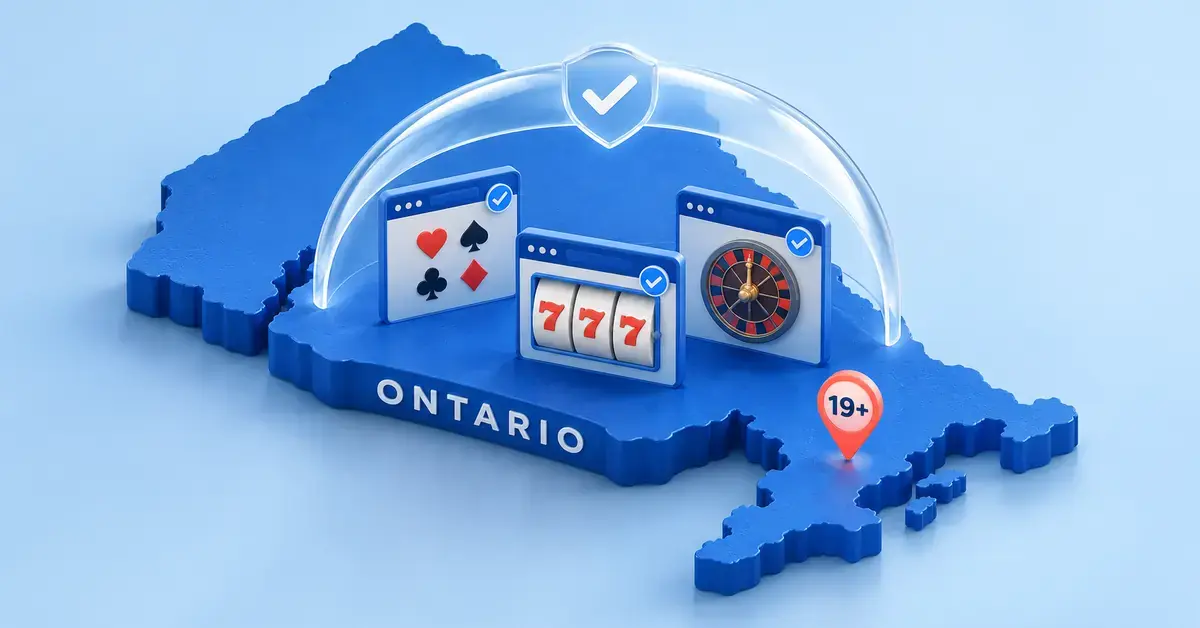
Yes. Online casino gambling is legal in Ontario, and the province runs the only open, competitive regulated iGaming market in Canada. Since 4 April 2022, private companies have been able to offer real-money online slots, table games and sports betting to people in Ontario — but only after they register with the provincial regulator and sign a commercial agreement with the province’s gaming agency. Playing on one of those licensed sites is lawful for anyone aged 19 or over who is physically located in Ontario. This guide explains how the market is structured, why it was created, how big it has become, and how to tell a legal site from an unregulated offshore one.
Key Facts
| Legal status | Legal and regulated since 4 April 2022 |
|---|---|
| Regulator | Alcohol and Gaming Commission of Ontario (AGCO) |
| Operator of the market | iGaming Ontario (iGO), a provincial agency |
| Legal model | Province “conducts and manages” gaming via operating agreements with private operators |
| Minimum age | 19 |
| Where it is valid | You must be physically located in Ontario |
| Registered operators | About 50 operators running 80+ sites (2026) |
| Government-run option | OLG.ca (separate from the iGO market) |
| Tax on winnings | None for recreational players |
How Ontario’s regulated iGaming market works
Ontario’s market is built on a simple legal rule: in Canada, only a provincial government may lawfully “conduct and manage” gambling. Ontario met that requirement by creating a public agency to run the market behind the scenes, while well-known betting brands handle the customer-facing side under contract. The result is a regulated space where private operators compete, but the province remains the legal conductor of the gaming.
What does “conduct and manage” mean?
Canada’s Criminal Code bans most gambling except where it is conducted and managed by a province. This is the same principle that underpins every legal casino and lottery in the country — you can read more in our overview of gambling and the Criminal Code of Canada. Ontario’s innovation in 2022 was to satisfy “conduct and manage” through a government agency, iGaming Ontario, which contracts with private operators rather than building every game itself. All Ontario player revenue flows through iGaming Ontario, which keeps it legally within the provincial framework.
What do the AGCO and iGaming Ontario each do?
Two separate bodies run the market, and the split matters. The Alcohol and Gaming Commission of Ontario (AGCO) is the independent regulator. It decides whether a company is eligible, registers operators and their suppliers, writes the Registrar’s Standards for Internet Gaming, monitors compliance and can impose penalties up to revoking a registration. iGaming Ontario (iGO) is the agency that actually “conducts and manages” the gaming: it signs and oversees the operating agreements, handles the money, sets responsible-gambling requirements and runs the anti-money-laundering program. iGO started in July 2021 as a subsidiary of the AGCO and became a stand-alone provincial agency in May 2025. For how this compares with other provinces’ bodies, see our guide to who regulates gambling in Canada.
How does a casino brand become legal in Ontario?
An operator needs two things before it can legally take a single Ontario bet. First, it must pass the AGCO’s eligibility review and be registered as an internet gaming operator. Second, it must sign an operating agreement with iGaming Ontario. Only when both are in place may the brand go live. Under the standard agreement, operators deposit their Ontario revenue with iGO; iGO’s published financial statements show it returns about 80% to the operator as compensation and retains roughly 20%, which covers its costs and returns a share to the Government of Ontario. A brand missing either the registration or the agreement is not operating legally in the province, no matter how large or familiar it is elsewhere.
What about OLG.ca?
OLG.ca, run by the Ontario Lottery and Gaming Corporation, sits outside the iGaming Ontario market. It is the government’s own online gaming and lottery site and predates the 2022 opening. iGO does not conduct or manage OLG.ca, although the AGCO’s standards still apply to it. In practice this means Ontario residents have two legal routes to online casino games: the government’s OLG.ca, and the registered private operators in the iGO market.
When and why did Ontario legalize online casinos?
Ontario opened its market to end a large, untaxed grey market, not to create demand that did not already exist. Before 2022, the only clearly legal online option was OLG.ca, yet hundreds of offshore sites openly advertised to Ontarians and took their money without any provincial oversight, consumer protection or tax contribution.
The province announced its plan to open a regulated market in its 2019 budget and spent the next three years designing the model and consulting operators. A separate but related change helped: in 2021, Parliament passed Bill C-218, which removed the Criminal Code ban on single-event sports betting and let provinces offer it. Ontario folded sports betting into the same new iGaming framework. The market launched on 4 April 2022 with a handful of operators live on day one and dozens more joining over the following months. The AGCO later received international regulatory-excellence awards for the framework it built.
How big is Ontario’s online casino market now?
Ontario’s regulated market has grown into one of the largest in North America. The figures below come from iGaming Ontario’s public market-performance reporting and are current as of late 2025 — treat them as a snapshot, since iGO updates them monthly.
- Total wagers (2025): players bet roughly CA$98 billion across the year, up about 26% on the previous year.
- Operator revenue (2025): around CA$4.0 billion in gross gaming revenue — the amount kept after paying out winnings.
- Since launch: cumulative operator revenue passed CA$10 billion between April 2022 and the end of 2025.
- Active player accounts: about 1.28 million in late 2025. Note that these are accounts, not unique people — one person can hold accounts with several operators.
- Operators: roughly 50 registered operators running more than 80 gaming sites as of 2026.
- Product mix: casino games (slots and table games) make up the large majority of wagers — around 85% — with sports betting the rest.
For the land-based side of the province’s gambling, which remains much larger in physical footprint, see our list of casinos in Ontario.
How do you know if an online casino is legal in Ontario?
The most reliable check is the AGCO’s public registry. Every legal operator in the iGaming Ontario market is registered with the AGCO and appears in its searchable registry of licensed businesses; legal sites also display the iGaming Ontario mark and link to responsible-gambling tools. If a site is not in the registry, it is operating outside Ontario’s framework — regardless of any logos it shows or claims it makes.
A few practical signals separate a regulated Ontario site from an unregulated one:
- It confirms you are physically in Ontario before letting you play.
- It verifies your age and identity (19+).
- It offers Ontario-specific responsible-gambling tools, including links to OLG’s My PlayBreak self-exclusion.
- It names iGaming Ontario and the AGCO, and appears in the AGCO registry.
Legal vs Unregulated Sites
| Feature | Ontario-regulated site | Unregulated offshore site |
|---|---|---|
| Oversight | AGCO + iGaming Ontario | None in Ontario |
| Legal to operate here | Yes (AGCO registration + iGO agreement) | No |
| Age & location checks | Required (19+, in Ontario) | Often weak or absent |
| Responsible-gambling tools | Mandatory, incl. self-exclusion | Not guaranteed |
| Dispute resolution | Formal process via iGO | Little or no recourse |
| Appears in AGCO registry | Yes | No |
Is it illegal to play on an offshore site from Ontario?
For the individual player, using an offshore site is a legal grey area rather than a prosecutable crime. Canada’s gambling laws are aimed at the operators who conduct unlicensed gaming, not at the people who place bets, and there is no record of Ontario residents being charged simply for playing on an offshore casino. That is very different from saying such sites are safe or sanctioned.
The real cost of an unregulated site is lost protection. Because these operators answer to no Ontario regulator, players have little recourse if a site refuses a withdrawal, changes its terms, mishandles personal data or shuts down holding customer funds. They are also outside Ontario’s responsible-gambling safeguards, such as mandatory self-exclusion and deposit controls. Research commissioned by the AGCO and iGaming Ontario has found that a meaningful share of online gamblers in Ontario still use unregulated sites — which is one reason the province keeps expanding the legal, safer alternative.
What are the rules for players in Ontario?
The player-side rules are straightforward, and all of them apply whichever legal site you use.
How old do you have to be?
You must be 19 or older to play online casino games or bet on sports in Ontario. The age is tied to where you are, not where you live: our guide to the legal gambling age in Canada by province shows how the 18-versus-19 line is drawn across the country.
Do you have to be in Ontario?
Yes. Legal operators use location technology to confirm you are physically within Ontario when you play. Being an Ontario resident is not enough on its own — if you cross into another province, you cannot legally play on an Ontario-licensed site from there. How online gambling is handled elsewhere is covered in our province-by-province explainer on whether online gambling is legal in Canada.
Do you pay tax on your winnings?
Recreational players in Ontario do not pay income tax on gambling winnings, including online casino wins. Canada treats casual winnings as a windfall rather than income. The full picture, including the narrow cases where winnings are taxed, is in our guide to tax on gambling winnings in Canada.
Common mistakes people make about online gambling in Ontario
Even in a regulated market, a few misunderstandings cause real problems:
- Assuming any site that accepts Canadians is legal. Many offshore casinos happily take Ontario players but are not registered with the AGCO. “Available” is not the same as “licensed.”
- Trusting a licence from another country. A Malta, Curaçao or UK licence means nothing in Ontario. Only AGCO registration plus an iGaming Ontario agreement makes a site legal here.
- Believing a strategy or bonus can beat the house. Regulated games run on audited random number generators and a built-in house edge; no system changes the long-run math.
- Playing from outside the province. Logging in from another province or country breaks the location rules and can void play.
- Treating free spins or bonuses as free money. Promotional offers carry wagering requirements and conditions that are easy to overlook.
How Ontario compares with the rest of Canada
Ontario is the outlier. Most provinces offer legal online casino games only through a single government-run platform — British Columbia’s PlayNow, Quebec’s Loto-Québec site, and similar monopoly platforms elsewhere. Alberta has legislated an open, competitive market modelled on Ontario’s but had not fully launched it at the time of writing. Ontario remains the only province where a wide field of private brands can legally compete for players under provincial oversight, which is why its market dwarfs the others in both choice and revenue.
A note on responsible gambling
This article is informational and is not gambling, legal or financial advice. Gambling carries real financial risk; a regulated market makes play safer, not risk-free, and no game or strategy improves your long-run odds against the house edge.
If gambling is causing you or someone you know harm in Ontario, free, confidential help is available 24/7 from ConnexOntario at 1-866-531-2600. Ontario players can also set deposit and time limits and sign up for OLG’s My PlayBreak self-exclusion. You must be 19 or older to gamble online in Ontario. For warning signs, help lines and self-exclusion options across Canada, see our guides to responsible gambling in Canada and casino self-exclusion programs in Canada.
Sources
- AGCO — Roles of the AGCO and iGaming Ontario
- iGaming Ontario — official site and market performance reports
- AGCO — Internet Gaming (igaming) regulation
- Government of Ontario — Internet gaming in Ontario
- DLA Piper — Ontario opens its online gambling market (April 2022)
- Canadian Gaming Business — iGaming Ontario market reporting and IPSOS research
- ConnexOntario — free, confidential problem gambling help
Frequently Asked Questions (FAQ)
Is online casino gambling legal in Ontario?
Yes. Online casino gambling has been legal and regulated in Ontario since 4 April 2022. Private operators can offer real-money casino games only after registering with the AGCO and signing an operating agreement with iGaming Ontario. The government’s own OLG.ca is also legal.
What is the legal age to gamble online in Ontario?
The minimum age is 19, and you must be physically located in Ontario when you play. Legal operators verify both your age and your location before accepting bets.
Are offshore online casinos illegal to use in Ontario?
Canadian law targets the operators who run unlicensed gaming, not the individual player, so residents are not prosecuted for using offshore sites. However, those sites are not regulated in Ontario, so you lose consumer protection, dispute resolution and responsible-gambling safeguards.
Do I pay tax on online casino winnings in Ontario?
No. Recreational gambling winnings, including online casino wins, are treated as a tax-free windfall in Canada. Tax can apply only in narrow cases, such as gambling carried on as a business.
How can I check whether an online casino is licensed in Ontario?
Search the AGCO’s public registry of registered gaming operators. A legal Ontario site appears in that registry, confirms you are in Ontario, verifies your age and displays the iGaming Ontario mark and responsible-gambling tools.
