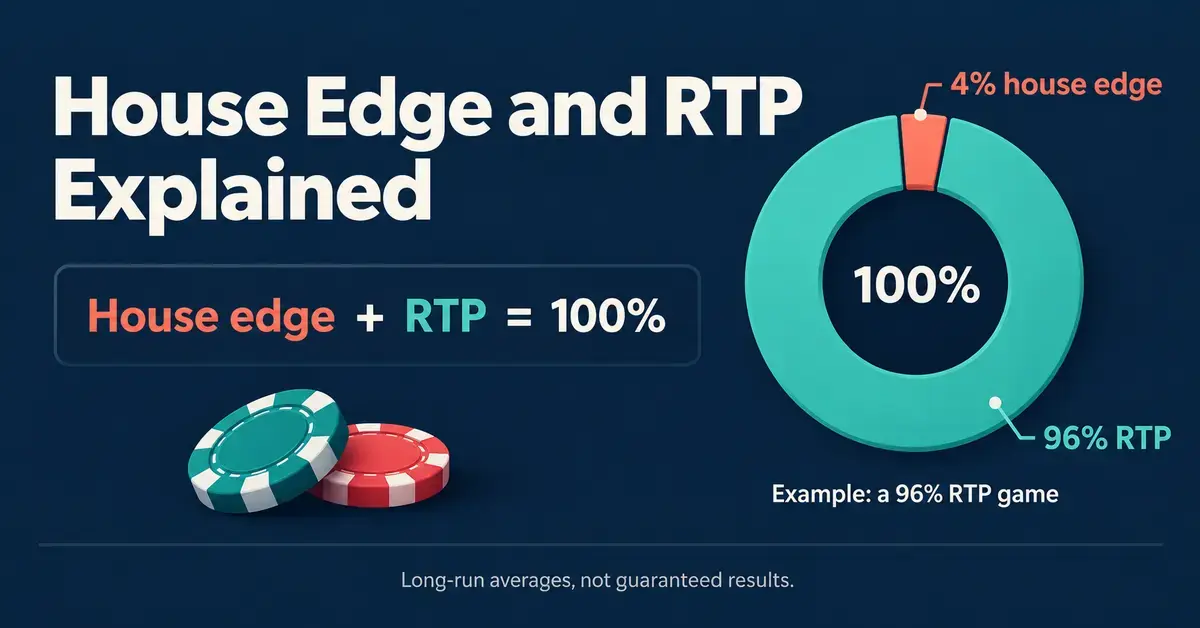
Every casino game is built around a small, permanent mathematical advantage for the operator. That advantage has two common names — the house edge and the return to player (RTP) — and they are simply two ways of describing the same number. Learning what they mean, and what they do not mean, is the single most useful thing anyone can do before deciding whether, and how much, to play. This guide explains both terms in plain English, shows the house edge for the main games in a comparison table, and explains why the house always comes out ahead over time — without any “systems” or promises of winning.
Key Points
- House edge is the casino’s average long-run profit margin on each bet; RTP (return to player) is the share paid back to players. They always add up to 100%.
- House edge = 100% − RTP. A 96% RTP slot has a 4% house edge.
- Lowest edges: basic-strategy blackjack (~0.5%), baccarat Banker (1.06%), craps Pass Line (1.41%). Highest: keno (20%+), American roulette (5.26%), some slots (up to ~15%).
- Both figures are long-run averages across huge numbers of bets — they do not predict a single session.
- The house wins over time because of the law of large numbers; no “system” can overcome a fair game’s edge.
- In Canada, payout rules are set by each province. Ontario requires regulated slots to return at least 85% over the machine’s life.
What is the house edge?
The house edge is the casino’s built-in profit margin, expressed as a percentage of each bet. It is the average amount the casino expects to keep from every dollar wagered on a game, over a very large number of bets. If a game has a 5% house edge, the casino expects to keep about 5 cents of every dollar bet on it in the long run — and return the other 95 cents to players as winnings.
Two points matter from the start. First, the house edge is an average over the long run, not a fee taken from each individual bet; on any single bet you can win far more than you staked or lose it all. Second, the edge is baked into the rules and payouts of the game itself. Roulette pays 35 to 1 on a single number even though a double-zero wheel has 38 pockets — that gap between the true odds (37 to 1) and the payout (35 to 1) is where the edge lives. You cannot remove it by betting differently, and no outside strategy changes the math of a fair, correctly run game.
What is RTP (return to player)?
RTP, or return to player, is the percentage of all money wagered that a game is designed to pay back to players over its lifetime. A slot with a 96% RTP is built to return $96 for every $100 wagered across all players and all spins combined. RTP is the term you will most often see on slot machines and online games, while “house edge” is used more often for table games — but they measure the same thing from opposite ends.
Three things are easy to misread about RTP:
- It is long-term and collective. RTP is measured across millions of spins by all players, not your personal session. Your own results in 50 or 500 spins can look nothing like the stated figure.
- It is set before anyone plays. RTP comes from the game’s underlying mathematics, not from how “hot” or “cold” a machine feels.
- The same game can have different RTP versions. One slot title might be available in 94%, 95% and 96% configurations, and the operator chooses which to run. The name on the screen does not guarantee a specific RTP.
House edge vs RTP: two sides of the same coin
The house edge and RTP always add up to 100%. One is simply what is left after the other. The formula is:
- House edge = 100% − RTP
- RTP = 100% − house edge
So a slot advertised at 96% RTP has a 4% house edge. A European roulette wheel with a 2.70% house edge has an RTP of 97.30%. Blackjack played with correct basic strategy can have a house edge near 0.5%, which is an RTP of roughly 99.5%. If you know one figure, you always know the other — there is no hidden third number.
House edge by game
House edge varies enormously between games, and even between bets within the same game. The table below shows typical figures for a correctly run, standard game; exact numbers shift with the specific rules, pay table and bet you choose. The percentages come from published casino-math figures (see the sources at the end).
House Edge by Game
| Game / bet | Typical house edge | Approx. RTP | Notes |
|---|---|---|---|
| Blackjack (basic strategy) | ~0.3%–0.5% | ~99.5%–99.7% | Requires correct strategy; rules change the figure |
| Baccarat (Banker) | 1.06% | 98.94% | Player bet ~1.24%; Tie ~14.36% |
| Craps (Pass Line) | 1.41% | 98.59% | Proposition bets can exceed 10% |
| Roulette (European, single zero) | 2.70% | 97.30% | One zero (0) |
| Roulette (American, double zero) | 5.26% | 94.74% | Two zeros (0 and 00) |
| Slot machines | ~2%–10% (up to ~15%) | ~85%–98% | Rarely posted; varies by machine and version |
| Keno | ~20%–35%+ | ~65%–80% | Among the worst odds in the casino |
Blackjack: the lowest edge, if you play correctly
Blackjack has the lowest house edge of any common casino game — roughly 0.5% under typical rules, and as low as about 0.3% under the most liberal ones — but only when the player follows basic strategy, the mathematically correct play for every hand. A player guessing or following hunches gives up several extra percentage points. Rule changes such as the dealer hitting a soft 17, or blackjacks paying 6 to 5 instead of 3 to 2, raise the edge noticeably.
Baccarat and craps: low edges on the main bets
In baccarat, the Banker bet carries about a 1.06% edge and the Player bet about 1.24%, while the Tie bet is a trap at roughly 14.36%. In craps, the Pass Line bet is about 1.41%, but many of the proposition bets in the centre of the table exceed 10%. In both games the headline bets are cheap and the exotic bets are expensive.
Roulette: the number of zeros decides everything
Roulette’s house edge is set entirely by how many zeros the wheel has. A single-zero (European) wheel has a 2.70% edge. A double-zero (American) wheel has a 5.26% edge — nearly double — for the same bets and the same payouts. Where you have the choice, the single-zero wheel is mathematically far cheaper to play.
Slots: a wide range and rarely posted
Slot machines typically carry a house edge of about 2% to 10%, and some run as high as 15%. That corresponds to an RTP of roughly 85% to 98%. Slots almost never display their RTP on the machine, which is why the figure is harder to judge than for table games. For more on the mechanics behind the reels, see the casino games explained hub.
Keno and wheel games: the worst odds in the room
Keno is one of the most expensive games in any casino, with a house edge commonly in the 20% to 35% range and sometimes higher, depending on the version and how many numbers you pick. Big-wheel “money wheel” games are similar. These games are built for entertainment value, not for value per dollar wagered.
Why the house always wins over time
The house always wins over time because of a statistical principle called the law of large numbers: the more bets are placed, the closer the actual results move to the mathematical average. On a single spin or hand, anything can happen — that short-term uncertainty is what makes gambling exciting, and it is why players do win, sometimes big. But as the number of bets grows into the thousands and millions, random swings cancel out and the built-in edge takes over.
The casino is not betting on any one outcome. It is playing millions of bets across thousands of players every day, so it sits firmly in the “long run” at all times. An individual player who sits down for an evening is exposed to short-term variance and can leave ahead. The more you play, the more your personal results converge toward the negative expectation set by the house edge. This is why no betting pattern, progression or “system” can overcome the edge on a fair game: changing your bet sizes does not change the percentage the game keeps.
What house edge and RTP do not tell you
House edge and RTP describe average long-run return, and nothing else. Two other factors shape what a session actually feels like:
- Volatility (variance). A high-volatility slot pays rarely but can pay large amounts; a low-volatility slot pays small amounts often. Two slots can share a 96% RTP yet behave completely differently from spin to spin.
- Hit frequency. How often a game returns anything at all is separate from how much it returns overall. A game can hit frequently with small wins and still have a high house edge.
RTP also says nothing about a single session. Over a few hundred bets your result is dominated by variance, not by the edge. A 97% game can take all your money in an hour, and a 90% game can send you home a winner for the night. RTP only asserts itself across a very large number of bets — which, for an individual, usually means the house keeps its edge long before you reach “the long run.”
Common mistakes players make about the odds
Misreading the math is as costly as choosing a high-edge game. The most frequent errors:
- Treating RTP as a session promise. A 96% RTP does not mean you get 96% of your money back tonight. It is a lifetime average across all players.
- Believing a machine is “due.” Each spin or hand is independent. A game that has not paid out is no more likely to pay on the next bet — this is the gambler’s fallacy.
- Chasing losses. Increasing bets to “win it back” raises your exposure to the house edge, not your chances. Over time, betting more simply loses more.
- Trusting betting systems. Martingale and similar progressions rearrange when you win and lose but never change the edge, and they run into table limits and finite bankrolls.
- Ignoring the rules and pay table. A 6-to-5 blackjack table or a double-zero roulette wheel quietly doubles or triples the edge versus the better version of the same game.
How house edge and RTP work in Canadian casinos
In Canada, payout rules are set province by province, because under the Criminal Code only the provinces may conduct and manage legal gambling. There is no single national minimum. Ontario is the clearest published example: the Alcohol and Gaming Commission of Ontario requires slot machines in regulated gaming facilities to pay out at least 85% over the life of the machine — a maximum house edge of 15% — and operators may set individual machines higher. Ontario’s 2022 Auditor General audit confirmed that 85% floor and flagged weaknesses in how closely it is monitored.
Other provinces set their own standards and do not always publish them, so you cannot assume Ontario’s figure applies nationwide. Table games in Canadian casinos follow the same math as anywhere else: single-zero roulette, basic-strategy blackjack and the main baccarat and craps bets carry the lowest edges. For how gambling is licensed and regulated across the country, see the overview of gambling laws in Canada, and for where these games are played, the guide to land-based casinos in Canada.
Responsible gambling disclaimer
This article is for general information only. It explains how casino odds work and does not encourage gambling, offer betting advice, or suggest that any game, strategy or “system” can produce a profit. The house edge means that, over time, casino games are designed to lose money for the player; no information on this page changes that. The legal gambling age in Canada is 19 in most provinces and 18 in Alberta, Manitoba and Québec. If gambling is affecting you or someone you know, free, confidential help is available — see our guide to responsible gambling in Canada for provincial help lines, self-exclusion programs and GameSense resources.
Sources
Frequently Asked Questions (FAQ)
What is the difference between house edge and RTP?
They are the same figure seen from opposite sides. The house edge is the share of each bet the casino keeps on average; RTP is the share returned to players. They always add up to 100%, so a 4% house edge equals a 96% RTP.
Which casino game has the lowest house edge?
Blackjack played with correct basic strategy has the lowest edge of the common games, around 0.5% under typical rules. The Banker bet in baccarat (about 1.06%) and the Pass Line in craps (about 1.41%) are the next lowest.
Does a high RTP mean I will win?
No. RTP is a long-run average measured across all players and millions of bets. In a single session, variance dominates, and even a high-RTP game is still designed to return less than you wager over time, so the expected result stays negative.
What RTP do slot machines in Canada have?
It varies by province and machine, and most machines do not display it. Ontario requires regulated slots to return at least 85% over the machine’s life, meaning a maximum house edge of 15%; many machines are set higher, but other provinces publish little or no data.
Can you beat the house edge?
Not on a fair, correctly run game through betting patterns or systems. Good play, such as blackjack basic strategy or choosing single-zero roulette, lowers the edge but never erases it. Over enough bets, the math favours the house.
