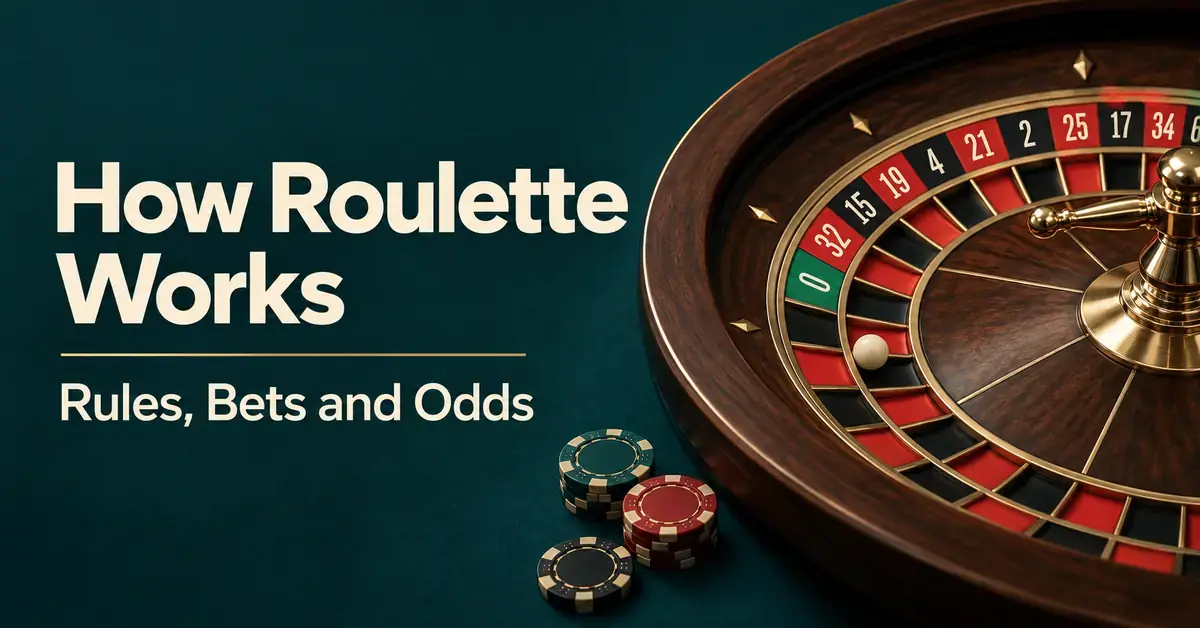
Roulette is one of the simplest casino games to play and one of the easiest to misunderstand. A dealer, called the croupier, spins a numbered wheel in one direction and rolls a small ball in the other; wherever the ball settles decides every bet on the table. This guide explains how roulette works from the ground up — the wheel layout, the full range of bets and what they pay, and exactly why the green zero gives the casino its mathematical edge. It is written as plain information, not as a method to beat the game, because no roulette bet or betting system changes the built-in odds.
Key Facts
- Game type: game of pure chance — no skill affects the result.
- European wheel: 37 pockets (1–36 plus a single green 0).
- American wheel: 38 pockets (1–36 plus 0 and 00).
- House edge: about 2.70% (European) and 5.26% (American) on standard bets.
- Source of the edge: the green zero(s), which the payouts ignore.
- Top payout: 35:1 on a single number (straight up).
- Betting systems: do not change the odds — every spin is independent.
- Legal age in Canada: 19 in most provinces; 18 in Alberta, Manitoba and Quebec.
What is roulette and how does a single round work?
Roulette is a game of pure chance in which players bet on where a ball will land on a spinning wheel of numbered pockets. There is no skill element that changes the result of a spin: once the wheel is turning and the ball is rolling, the outcome is fixed by physics and probability, not by any decision the player makes.
A single round follows the same sequence every time:
- Players place bets. Chips are placed on a numbered betting layout that corresponds to the pockets on the wheel. You can bet on one number, several numbers at once, or large groups such as all red numbers.
- The croupier spins the wheel and rolls the ball. The ball travels around the rim in the opposite direction to the wheel.
- “No more bets.” The croupier closes betting while the ball is still moving, so no one can bet once the result becomes predictable.
- The ball settles into a pocket. That pocket’s number and colour is the winning result.
- Losing chips are cleared and winners are paid at fixed odds set by the type of bet.
Each spin is independent. The wheel has no memory, so a previous result has no effect on the next one. Roulette is one of several games covered in our overview of how casino games work and their odds.
How is the roulette wheel laid out?
The wheel is a rotating disc divided into numbered pockets, and the number of pockets is the single most important thing about any roulette table. The two standard versions differ by exactly one pocket, and that one pocket roughly doubles the cost of playing.
- European (single-zero) wheel: 37 pockets — the numbers 1 to 36 plus a single green 0.
- American (double-zero) wheel: 38 pockets — the numbers 1 to 36 plus a green 0 and a green 00.
On both wheels the 36 numbered pockets are split evenly into 18 red and 18 black, which alternate around the rim. The zero (and the double zero, where present) is green and breaks the red-black pattern. That green pocket is not decoration — it is the entire source of the house’s advantage, explained further below.
The numbers are not arranged in counting order around the wheel. They are deliberately scattered so that high and low, odd and even, and red and black are balanced around the rim. The standard European sequence, read clockwise from zero, is: 0, 32, 15, 19, 4, 21, 2, 25, 17, 34, 6, 27, 13, 36, 11, 30, 8, 23, 10, 5, 24, 16, 33, 1, 20, 14, 31, 9, 22, 18, 29, 7, 28, 12, 35, 3, 26. The American wheel uses its own distinct order. Knowing the sequence tells you which numbers are physical neighbours, but it does not change the probability of any spin.
The betting layout on the table is organised differently from the wheel — the numbers appear in a grid of three columns so that bets on groups of numbers are easy to place.
What are the bet types and payouts in roulette?
Roulette bets divide into two families: inside bets on single numbers or small clusters, which pay more but win rarely, and outside bets on large groups, which pay less but win often. The payout is quoted as “to one” — a 35:1 bet returns 35 chips in winnings plus your original 1 chip.
Inside bets
Inside bets are placed directly on the numbered grid and carry the biggest payouts because they cover the fewest numbers.
- Straight up — one number, pays 35:1.
- Split — two adjacent numbers, pays 17:1.
- Street — a row of three numbers, pays 11:1.
- Corner (square) — four numbers meeting at a corner, pays 8:1.
- Line (double street) — six numbers across two rows, pays 5:1.
American wheels also offer a five-number bet on 0, 00, 1, 2 and 3, which pays 6:1. It is the one bet to avoid: its house edge is 7.89%, higher than every other bet on the table.
Outside bets
Outside bets sit around the edge of the layout and cover large groups of numbers, so they win close to half the time but pay little.
- Red or black, odd or even, high (19–36) or low (1–18) — 18 numbers each, pay 1:1 (even money).
- Dozens (1–12, 13–24, 25–36) and columns — 12 numbers each, pay 2:1.
A common beginner assumption is that even-money bets are a coin flip. They are not: the green zero means red and black together cover only 36 of 37 (or 38) pockets, so each pays slightly less than a true 50/50 chance would.
Bets and Payouts
| Bet | Numbers covered | Payout | Win chance (European) | Win chance (American) |
|---|---|---|---|---|
| Straight up | 1 | 35:1 | 2.70% | 2.63% |
| Split | 2 | 17:1 | 5.41% | 5.26% |
| Street | 3 | 11:1 | 8.11% | 7.89% |
| Corner | 4 | 8:1 | 10.81% | 10.53% |
| Line (double street) | 6 | 5:1 | 16.22% | 15.79% |
| Five-number (American only) | 5 | 6:1 | — | 13.16% |
| Dozen / Column | 12 | 2:1 | 32.43% | 31.58% |
| Red/Black, Odd/Even, High/Low | 18 | 1:1 | 48.65% | 47.37% |
Where does the house edge come from?
The house edge in roulette comes entirely from the green zero (and double zero). The wheel pays winners as if there were only 36 pockets, but there are actually 37 or 38 — and the casino keeps the difference over time.
A straight-up bet pays 35:1. That would be a fair, break-even price only if the wheel had exactly 36 pockets. Because the extra green pocket(s) exist, the payout is slightly short of fair, and that shortfall is the edge. The clearest way to see it is the expected value of a $1 straight-up bet:
- European wheel: you win $35 once every 37 spins and lose $1 the other 36 times. Expected value = (35 − 36) ÷ 37 = −1/37 ≈ −2.70%.
- American wheel: you win $35 once every 38 spins and lose $1 the other 37 times. Expected value = (35 − 37) ÷ 38 = −2/38 ≈ −5.26%.
This edge is the same for almost every standard bet on a given wheel. A split pays 17:1 against a fair price of 18:1, a dozen pays 2:1 against a fair 2.0833:1, and so on — all of them work out to 2.70% on a European wheel and 5.26% on an American one. Changing your bet changes how often you win and how much you win, but not the casino’s long-run cut. (The exception is the American five-number bet at 7.89%.) The house edge is the mirror image of return to player, or RTP: a 2.70% edge is the same as 97.30% RTP.
In plain money terms, for every $100 wagered you can expect to lose about $2.70 on a European wheel and about $5.26 on an American wheel over the long run — which is why the choice of wheel matters more than the choice of bet.
European vs American roulette: which costs less to play?
European roulette costs roughly half as much to play as American roulette, because its single zero produces a 2.70% edge versus 5.26% for the double-zero American wheel. If both are offered, the single-zero wheel is always the mathematically cheaper game. There is also a French roulette layout, which is a single-zero wheel with the two rules below that lower the edge further on even-money bets.
What are La Partage and En Prison?
La Partage and En Prison are two optional rules on some single-zero tables that soften the loss when the ball lands on zero. With La Partage, an even-money bet (such as red) loses only half its stake if zero hits. With En Prison, the bet is instead held (“imprisoned”) for the next spin and returned in full if it then wins. Either rule cuts the house edge on even-money bets to about 1.35%, the lowest edge available at a roulette table. They apply only to even-money bets and only where the casino offers them.
Do betting systems change the odds in roulette?
No betting system changes the odds or the house edge in roulette. Systems such as the Martingale rearrange how much you stake and when, but they cannot turn a negative-expectation game into a positive one, because every spin is independent and carries the same fixed edge.
The Martingale is the best-known example: you double your bet after every loss so that the first win recovers everything plus one unit. It feels safe because small wins come often, but it has two fatal flaws. The required stake grows explosively — a $10 base bet becomes $5,120 after just nine losses — and table limits plus a finite bankroll mean a losing streak eventually stops you before you can recover. The system simply trades many small wins for an occasional catastrophic loss, and the average outcome is still a loss at the game’s fixed edge.
Systems also lean on the gambler’s fallacy: the mistaken belief that a result is “due” after a streak. If red has landed ten times in a row, the chance of red on the next spin is still exactly 18/37 (or 18/38). The ball and wheel have no memory of earlier spins, so no pattern of past results makes any future result more or less likely.
What mistakes do roulette players most often make?
The most common mistakes come from misreading the odds rather than from poor “play,” since there is no skilful play to get wrong.
- Playing the American wheel when a European one is available. This almost doubles the long-run cost for no benefit.
- Treating even-money bets as 50/50. The green zero means they are not; red covers 18 of 37 pockets, not 18 of 36.
- Chasing losses with a doubling system. As shown above, this increases the size of the eventual loss rather than preventing it.
- Believing numbers are “due.” Tracking a scoreboard of recent results has no predictive value.
- Taking the American five-number bet. At 7.89%, it is the worst bet on the table.
- Playing without a set budget. Because the edge is permanent, the only reliable control a player has is how much and how long they wager.
Who is roulette suited to, and where can you play it in Canada?
Roulette suits players who want a simple, social game of chance and who treat the stake as the price of entertainment rather than an investment. It needs no strategy and no learning curve, which is part of its appeal — but that same simplicity means there is no way to shift the odds in your favour.
In Canada, roulette is offered at licensed land-based casinos in every province that has them, and both single-zero and double-zero wheels appear depending on the venue. You can see where these casinos are in our guide to land-based casinos in Canada by province. All casino gambling in Canada is conducted and managed by the provinces, as set out in our overview of how gambling is regulated in Canada. The legal age to enter a casino is 19 in most provinces and territories and 18 in Alberta, Manitoba and Quebec.
Disclaimer
This article is for general information only. It explains how roulette works and is not gambling advice, legal advice or an encouragement to gamble. Roulette is a game of chance with a permanent house edge; no bet, pattern or betting system can overcome it, and over time the game is designed to return less than is wagered. Only ever gamble with money you can afford to lose, and only if you are of legal age — 19 in most of Canada, 18 in Alberta, Manitoba and Quebec.
If gambling is affecting you or someone you know, free, confidential help is available across Canada. See our responsible gambling help and resources for Canada for provincial help lines, self-exclusion programs and the warning signs of problem gambling.
Sources
Frequently Asked Questions (FAQ)
Is roulette a game of skill or luck?
Roulette is pure luck. Once betting closes, the result depends only on where the ball lands, and no decision by the player can influence it. Unlike blackjack or poker, there is no skill element that improves your odds.
What is the house edge in roulette?
On a European single-zero wheel the house edge is about 2.70% on standard bets. On an American double-zero wheel it is about 5.26%. The edge comes from the green zero pocket(s), which the payouts ignore.
What is the difference between European and American roulette?
European roulette has 37 pockets with one green zero; American roulette has 38 pockets with a zero and a double zero. The extra pocket raises the house edge from 2.70% to 5.26%, making the European wheel cheaper to play.
Which roulette bet has the best odds?
On a plain single-zero wheel every standard bet carries the same 2.70% edge, so none is mathematically better. Where La Partage or En Prison rules apply, even-money bets have the lowest edge at about 1.35%. The American five-number bet is the worst at 7.89%.
Can a betting system help me win at roulette?
No. Systems like the Martingale change your stake sizes but not the odds, because each spin is independent and carries the same fixed edge. They can produce short winning runs but lose on average over time.
